5 Dimensions of Premium Freeze Dried Strawberry Quality: From Rehydration to Moisture Content
3 月-30-2026
Quick Summary
- Visual & Structural Integrity: Premium strawberries must retain natural red pigmentation and a porous structure without excessive dust or “fines.”
- Moisture Content (< 5%): The golden rule for long shelf life and perfect crunch. High moisture leads to rapid degradation and microbiological risks.
- Rehydration Efficiency: High-quality FD strawberries should rehydrate within 30 to 60 seconds, returning nearly to their fresh state in cellular structure.
- Flavor & Brix Levels: Sourcing starts at the farm; the balance of natural sugars and acidity determines the final flavor profile without artificial additives.
- Compliance & Traceability: Partnering with a certified freeze dried fruit supplier China ensures adherence to global standards like BRCGS, IFS, and strict pesticide limits.
If you have spent any significant time in the global food procurement sector, you already know that not all dried fruits are created equal. When sourcing ingredients for a multinational cereal brand, a boutique chocolate line, or an emerging functional snack company, the margin for error is razor-thin. A bad batch of fruit does not just mean a lost shipment; it means stalled production lines, compromised brand reputation, and significant financial losses.
Over the years, sitting across the table from procurement managers and R&D directors, I have seen the same recurring issue: buyers often default to the lowest price per kilogram without understanding the hidden costs of poor processing. Today, the industrial food sector is shifting aggressively away from traditional dehydration and vacuum frying, moving toward premium freeze-drying technologies.
The freeze dried strawberry is perhaps the most heavily traded, yet most misunderstood, commodity in this space. Because of its delicate cellular structure, high natural sugar content, and susceptibility to moisture, the strawberry acts as a perfect litmus test for a factory’s technological capabilities. In this comprehensive guide, we will break down the five critical dimensions you must evaluate when auditing a supplier, ensuring that your next bulk order meets the rigorous demands of modern food manufacturing.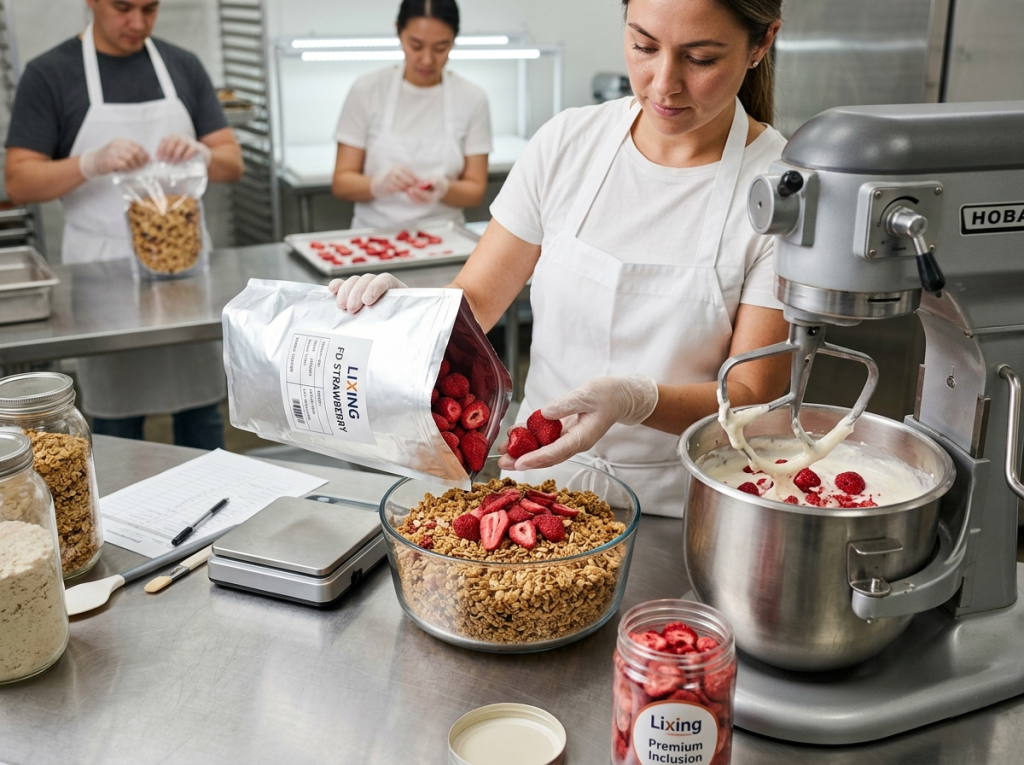
Dimension 1: Visual Integrity, Color, and Zero-Dust Processing
The first interaction your end-consumer has with your product is visual. In applications like transparently packaged trail mixes, yogurt toppings, or premium chocolate bars, the aesthetic appeal of the fruit inclusion is paramount.
The Science of Natural Pigmentation
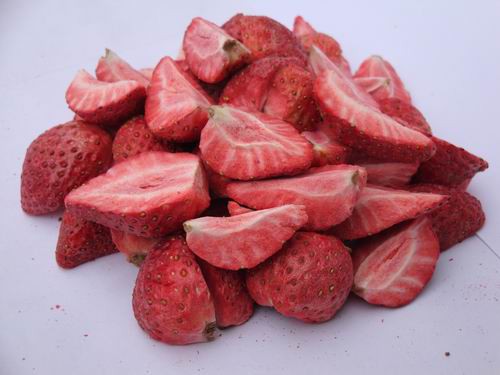
A top-tier freeze dried strawberry manufacturer understands that vibrant color should never come from artificial dyes. The freeze-drying (lyophilization) process, when executed correctly, locks in the natural anthocyanins responsible for the strawberry’s red hue. If a sample arrives looking dull, brown, or inconsistently colored, it indicates a failure in the cold chain prior to processing, or an improper temperature curve during the sublimation phase. The fruit was likely oxidized before it even hit the vacuum chamber.
Structural Integrity and the “Porous Cell”
Unlike hot air drying, which shrivels the fruit, freeze-drying removes water while the fruit is frozen. The ice transitions directly into vapor (sublimation), leaving behind a rigid, porous cellular matrix. This matrix is what gives the fruit its original size and shape. When you inspect a batch, the slices or whole berries should look nearly identical to fresh fruit, simply lacking water weight. If the fruit appears collapsed or shrunken, the vacuum pressure was likely unstable during production.
Managing Fines and Dust
This is where many suppliers fail the B2B test. “Fines” refer to the microscopic dust and tiny broken fragments that accumulate at the bottom of a bulk box. While some breakage is inevitable during trans-oceanic shipping, excessive dust indicates poor slicing techniques or over-drying. If you are purchasing from a freeze dried strawberry powder factory, dust is the goal. However, if you are buying slices or dices for a cereal application, paying for 10% dust in a 10kg bulk carton is a direct loss to your ROI. Premium factories use specialized vibratory sieves to remove these fines before the product is sealed in moisture-barrier bags.
Dimension 2: The Critical Moisture Threshold
If there is one metric that dictates the commercial viability of your supply chain, it is the moisture content. In the realm of lyophilization, water is the enemy of stability.
The < 5% Rule and Water Activity (aw)
For a freeze dried strawberry to maintain its signature crunch and resist microbial growth, its total moisture content must strictly remain below 5% (with many premium grades targeting 2% to 3%). Just as importantly, the water activity (aw)—which measures the free water available for microbial growth—must be below 0.3.
When moisture creeps up to 6% or 7%, the fruit becomes pliable, chewy, and highly susceptible to mold. In B2B procurement, moisture also equates to weight. If you buy a container of fruit with 8% moisture instead of 3%, you are quite literally paying premium freight and commodity prices for water.
Real-World Shelf Life Impact
Let us look at how moisture directly correlates to warehouse stability. When evaluating a bulk freeze dried fruit wholesale partner, require them to provide Certificates of Analysis (COA) proving their moisture control.
| Moisture Content | Water Activity (aw) | Texture / Mouthfeel | Estimated Shelf Life (in Mylar) | Industrial Application Suitability |
| < 3% | < 0.20 | Highly crisp, easily shatters | 18 – 24 Months | Ideal for chocolate, dry powder blends |
| 3% – 5% | 0.20 – 0.30 | Crisp, standard crunch | 12 – 18 Months | Cereals, granola, trail mixes |
| 6% – 8% | 0.35 – 0.45 | Soft, slightly spongy | 6 – 9 Months | Unacceptable for most crisp applications |
| > 8% | > 0.50 | Chewy, clumping | < 6 Months (High risk) | Rejection grade / High microbial risk |
Packaging as the First Line of Defense
Achieving low moisture in the factory is useless if the packaging fails during transit. Premium manufacturers pack their bulk products in high-density aluminum foil bags (often double-bagged), flushed with food-grade nitrogen to displace oxygen and moisture. Corrugated outer cartons should be robust enough to withstand the stacking pressure of a full 40HQ container without compressing the fragile bags inside.
Dimension 3: Rehydration Science and Sensory Evaluation
Freeze-dried fruit has a dual identity. In a snack bar, it needs to be crispy. In an instant oatmeal or a premium cup of instant noodles, it needs to absorb hot water instantly and taste like fresh fruit. This capability is known as the rehydration ratio.
The 30-Second Submersion Test
A reliable way to test the quality of a freeze dried strawberry is the 30-second submersion test. Take a standard 5mm slice and drop it into ambient temperature water or milk. A premium product will act like a microscopic sponge. Because the sublimation process leaves the cellular walls intact but empty of water, the liquid rushes back into these capillaries immediately. Within 30 to 60 seconds, the fruit should swell back to its original size, and the texture should closely mimic a freshly thawed strawberry.
If the fruit takes minutes to rehydrate, retains a hard core, or turns into mush, the drying curve was incorrectly programmed. Often, this means the exterior of the fruit was dried too quickly, causing “case hardening” which traps ice inside and destroys the cell walls.
Application Matching
Understanding rehydration helps you specify the right cut for your product.
-
For Beverages/Teas: You want fast rehydration to release flavor quickly.
-
For Yogurts: You want a moderate rehydration rate so the fruit absorbs some dairy moisture but retains a slight bite.
-
For Chocolate: Rehydration is completely undesirable. The fruit must be fully enrobed in fat to prevent ambient moisture from ruining the temper of the chocolate.

Dimension 4: Flavor Profile, Brix Levels, and Cultivar Selection
A factory can have the most advanced aerospace-grade vacuum chambers in the world, but if they feed garbage into the machine, they will get freeze-dried garbage out. The quality of the final product is inextricably linked to the agricultural source.
The Brix/Acid Balance
In the fresh produce industry, “Brix” is the measurement of sugar content. Strawberries are notorious for having wildly fluctuating Brix levels depending on the weather, the soil, and the harvest time. A seasoned freeze dried fruit supplier China will have deep, vertically integrated relationships with local farms.
They do not just buy whatever is leftover at the fresh market. They contract specific cultivars (like the American ‘Camarosa’ or local high-yield sweet varieties grown in Shandong or Fujian provinces) that boast a naturally high Brix-to-acid ratio. The freeze-drying process concentrates everything. It removes water, meaning the sugars and acids are intensified. If a strawberry is slightly sour when fresh, it will be overwhelmingly tart when freeze-dried.
The “No Added Sugar” Imperative
In the past, some secondary factories would soak inferior, low-Brix strawberries in sucrose or apple juice concentrate before freezing them to artificially boost sweetness and weight. In today’s market, driven by “Clean Label” initiatives and strict European and North American dietary guidelines, this is a massive red flag. Your supplier must guarantee a 100% single-ingredient profile, ensuring that the sweetness is derived entirely from the natural fructose of the berry.
Dimension 5: Global Compliance, MRLs, and Traceability
As an overseas buyer, your greatest risk is not just a bad tasting product; it is a product that gets stopped at Customs or triggers a consumer recall.
Navigating International Certifications
When vetting a factory, do not just ask if they are “registered.” Demand to see up-to-date certificates for GFSI-recognized schemes. BRCGS (British Retail Consortium Global Standards) and IFS (International Featured Standards) are the gold standards for European and North American markets. HACCP (Hazard Analysis and Critical Control Points) is the absolute bare minimum baseline.
A factory holding an A-grade BRC certificate has already undergone rigorous third-party auditing of their sanitation SOPs, glass policies, allergen controls, and pest management. This severely reduces your operational risk.
The Pesticide Gap (MRL Compliance)
Different countries have vastly different Maximum Residue Limits (MRLs) for agricultural chemicals. What is perfectly legal for domestic consumption in Asia might trigger a catastrophic rejection at a port in Hamburg or Los Angeles. Your freeze dried strawberry supplier must have an internal testing protocol, ideally partnering with internationally recognized third-party labs like SGS, Eurofins, or Merieux NutriSciences, to test raw materials before they enter the facility, and finished goods before they are loaded onto a vessel.
Full-Circle Traceability
In 2026, transparency is non-negotiable. If a customer finds a foreign object in a strawberry piece, you need to be able to contact your supplier, provide a lot number, and have them trace that exact batch back to the specific field it was harvested from, the date it was processed, and the operator running the machine.
Industrial Processing Comparison: Why Pay the Premium?
Procurement departments often ask: “Why should we pay $20+ per kilogram for freeze-dried fruit when hot-air dried fruit is a fraction of the cost?” The answer lies in the uncompromising quality of the end product.
| Processing Technology | Nutrient Retention | Shape & Volume Retention | Rehydration Capacity | Sensory Quality | Cost Profile |
| Freeze-Drying (FD) | > 95% (Vitamins intact) | Excellent (Original shape) | Instant & complete | Natural, vivid, crisp | High / Premium |
| Hot Air Drying (AD) | ~ 50% (Heat degrades vit C) | Poor (Shrunken, dense) | Very slow, incomplete | Chewy, altered flavor | Low / Economical |
| Vacuum Frying (VF) | ~ 70% | Good | None (Oil saturated) | Greasy, added calories | Medium |
For a budget trail mix, AD might suffice. But for a premium health brand, substituting FD with AD destroys the product’s value proposition. The ROI of using premium FD ingredients is realized through higher retail pricing power and stronger consumer brand loyalty.
Vetting Your Wholesale Partner: The Expert’s Checklist
Before you wire a 30% deposit across the globe, act like a seasoned auditor. When speaking with a potential manufacturer, ask these specific questions:
-
What is your sublimation cycle time for 5mm strawberry slices? (A cycle that is too fast, e.g., under 12 hours, indicates rushed production that causes case-hardening. A proper cycle usually takes 16-24 hours).
-
Can you provide a recent heavy metal and pesticide residue report from a third-party lab?
-
How do you handle metal detection and X-ray sorting? (Every single box should pass through a calibrated metal detector before palletization).
-
Do you have an in-house microbiological lab? (They should be testing for E.coli, Salmonella, Listeria, and Total Plate Count on every batch).
-
What is your protocol for managing fines and broken pieces?
If the sales representative stumbles over these questions, you are likely dealing with a trading company masquerading as a factory, or a manufacturer that cuts corners.
Looking Ahead: Market Trends for 2026
The global demand for premium FD fruit quality standards is evolving rapidly. We are seeing a massive surge in demand from the functional beverage sector, where freeze-dried fruit powders and small particulates are used in instant smoothies and pre-workout blends.
Furthermore, sustainability is becoming a purchasing criterion. The best factories are investing in energy-recovery systems to offset the high electricity costs of refrigeration and vacuum pumps. As you build your supply chain, partnering with a forward-thinking manufacturer ensures your brand remains competitive and compliant for the next decade.
Conclusion: Quality is the Ultimate Cost-Saver
Sourcing the perfect freeze dried strawberry is not about finding the cheapest quote on an B2B directory. It is a highly technical procurement process that requires a deep understanding of thermodynamics, agriculture, and global food safety laws. By strictly evaluating the five dimensions—Visual Integrity, Moisture Content, Rehydration Science, Flavor Profile, and Compliance—you insulate your brand from catastrophic supply chain failures.
Remember, in the industrial food sector, you are not just buying dehydrated fruit. You are buying stability, safety, and the peace of mind that when your container arrives, it performs exactly as engineered. Choose your partners wisely, demand transparency, and never compromise on the fundamental science of quality.
1. What is the standard shelf life of bulk freeze dried strawberries?
When processed correctly to a moisture content of less than 5% and stored in unopened, nitrogen-flushed, moisture-barrier packaging (like thick aluminum Mylar bags), bulk freeze-dried strawberries typically have a shelf life of 18 to 24 months. The storage environment should ideally be cool, dry, and away from direct sunlight to prevent color degradation. Once the bulk packaging is opened, the fruit must be used rapidly or resealed hermetically, as it will aggressively absorb ambient humidity.
2. How can I tell if a freeze dried strawberry manufacturer uses added sugars or colors?
A pure, high-quality freeze-dried strawberry will only list “100% Strawberry” on its specification sheet. Visually, pure berries have a natural, slightly matte red appearance with visible, natural seeds. If the fruit looks unnaturally glossy, excessively bright red, or leaves a sticky residue, it may have been infused with sugar syrups or dyed before the freezing process. You can also review the Certificate of Analysis (COA) to check the Brix levels; abnormally high sugar content compared to standard agricultural data is a clear indicator of additives.
3. Why is the moisture content critical for a freeze dried strawberry powder factory?
For a factory producing freeze-dried strawberry powder, moisture control is the single most critical factor to prevent “caking” or clumping. Because powder has an exponentially larger surface area than whole slices, it absorbs atmospheric moisture almost instantly. If the powder’s initial moisture exceeds 3% to 4%, it will solidify into hard blocks during transit, rendering it useless for automated mixing lines in beverage or baking applications. Strict moisture control ensures the powder remains free-flowing.
4. What is the typical rehydration ratio for premium freeze dried fruit?
The rehydration ratio measures how much water the freeze-dried fruit can absorb compared to its dry weight. For premium freeze-dried strawberries, the rehydration ratio is typically around 1:10 to 1:12. This means that 10 grams of freeze-dried strawberry will absorb enough water to return to roughly 100 to 120 grams of “wet” weight, closely mimicking the original fresh fruit’s cellular volume. This rapid absorption should occur within 30 to 60 seconds in ambient temperature liquids.
5. Are there specific storage requirements for bulk freeze dried fruit wholesale orders?
While freeze-dried fruit does not require refrigerated or frozen cold-chain logistics (which is a primary cost-saving benefit), it does require strict ambient controls. Bulk wholesale orders should be stored in a clean, pest-free warehouse with a stable temperature preferably below 25°C (77°F) and relative humidity (RH) below 50%. The most critical requirement is maintaining the integrity of the master cartons; any puncture to the internal foil bags will immediately compromise the product, regardless of warehouse conditions.
[Contact our engineering team today to review your tech pack and plan your all-weather collection.]