How to Evaluate a Freeze-Dried Fruit Supplier for Long-Term Bulk Orders
8 月-05-2026
A sample may look and taste good, but long-term purchasing involves a different set of questions. Can the supplier maintain consistent product specifications across batches? Can it manage repeat orders and seasonal raw material changes? Are quality documents available for review? Can packaging, labeling, and shipping requirements be handled reliably?
For food manufacturers, wholesalers, distributors, and importers, evaluating these factors before placing a large order can help reduce supply risks and build a more dependable sourcing process.
What to evaluate: Manufacturing capabilities, quality management, supply stability, customization, batch consistency, export readiness, and commercial terms.
1. Evaluate the Factory’s Manufacturing Capabilities
The first step is to understand whether a potential supplier has the manufacturing capabilities required for your products and order volumes. 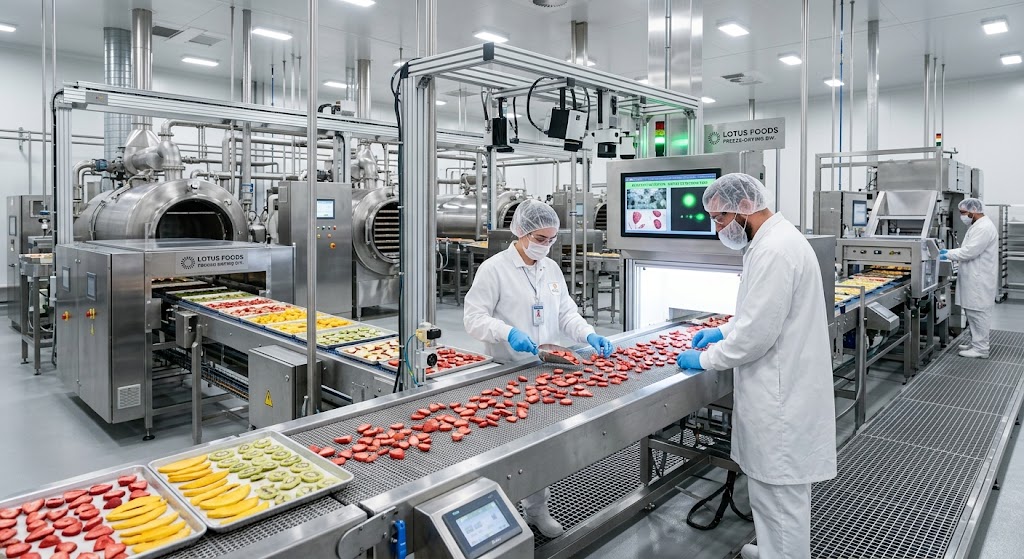
Check the Product Range
Confirm which freeze-dried fruits the manufacturer currently supplies and which product forms are available. Depending on the factory’s actual product range, these may include whole pieces, slices, dices, chunks, or powders.
Do not assume that every supplier can manufacture every fruit type or format. Ask which products are part of its regular production range and which require a custom arrangement.
Understand Production and Processing Arrangements
Ask how the supplier manages production planning, raw material preparation, processing, packaging, and finished-product inspection.
If production involves multiple facilities or outside processing partners, clarify which company is responsible for quality control and final product release. The goal is to understand how the supplier manages production and takes responsibility for the goods delivered.
Assess Capacity Against Your Order Plan
A large advertised capacity does not automatically mean a supplier can meet your delivery schedule. Ask about the availability of your required products, normal production lead times, and how repeat orders are scheduled.
Share a realistic estimate of your initial order and expected reorder frequency. This gives the supplier a clearer basis for discussing production planning and supply arrangements.
2. Review Quality Management and Food Safety Controls
For long-term bulk purchasing, quality consistency is just as important as product availability. A supplier should be able to explain its quality management process and provide relevant documentation for review.
Request Product Specifications
Ask for a current specification sheet for each product under consideration. Depending on the product, relevant parameters may include:
- Fruit variety and ingredient composition
- Product form and particle size
- Moisture content and water activity, where specified
- Color, flavor, aroma, and appearance
- Microbiological criteria
- Packaging details and storage conditions
- Shelf life and applicable date coding
The specific requirements should match the intended application, destination market, and agreed product specification. Do not rely on general statements such as “premium quality” without measurable acceptance criteria.
Verify Applicable Certifications and Documents
Ask which food safety management certifications and other compliance documents the supplier currently holds, if any. Confirm the issuing organization, scope, validity, and whether the documents apply to the facility and products relevant to your order.
Depending on your business and destination market, you may also need an ingredient declaration, Certificate of Analysis (COA), allergen information, microbiological test results, or other supporting documents.
Certification names alone are not enough. Buyers should verify documents against their own supplier approval requirements and the regulations applicable to the finished product.
Understand Batch Testing and Traceability
Ask how finished products are inspected, how batches are identified, and what happens when a result falls outside the agreed specification.
A useful supplier should be able to explain how it traces a finished batch to relevant production and raw material records, subject to its actual traceability system. Clarify whether batch-specific documentation can be supplied with each shipment when required.
3. Assess Supply Stability for Repeat Orders
A supplier that can fulfill one order may not necessarily be the right partner for a recurring supply program. Long-term buyers should evaluate the supplier’s ability to manage product availability, changing demand, and production schedules.
Ask About Raw Material Availability
Freeze-dried fruit production depends on the availability and quality of suitable fruit raw materials. Availability may vary by fruit variety, harvest period, origin, and market conditions.
Ask how the supplier manages raw material sourcing and how seasonal changes may affect your selected products. Discuss how availability changes are communicated and how alternatives are approved before use.
Confirm Lead Times and Reorder Planning
Request realistic lead times for samples, initial orders, and repeat orders. These may differ depending on product availability, order size, packaging requirements, and production schedules.
For ongoing supply, discuss how far in advance purchase orders should be placed and what information the supplier needs to schedule production. If your business has seasonal promotions or fixed production windows, communicate those requirements early.
Discuss Contingency Communication
No supplier can guarantee that every disruption will be avoided. What matters is whether potential problems are communicated clearly and managed through an agreed process.
Ask how the supplier handles delays, raw material changes, quality issues, or unexpected changes in availability. Agree on the appropriate contact person, notification expectations, and approval process for proposed changes.
4. Confirm Custom Specifications and OEM Requirements
Many bulk buyers need more than a standard product from a catalog. They may require specific fruit cuts, particle sizes, packaging formats, or labeling arrangements.
Product Form and Size
Clarify whether you need whole pieces, slices, dices, chunks, or powder, and specify the required dimensions or size range where applicable.
If the product is used as an ingredient in cereal, chocolate, bakery products, snack mixes, or other food applications, the desired form may affect how it is handled and how it performs in the finished product.
Ask whether the requested specification is part of the manufacturer’s regular range or requires a separate production arrangement. Request a representative sample for approval.
Ingredient and Quality Requirements
Specify the required ingredient composition and any restrictions relevant to your product. Confirm whether you need a single-ingredient fruit product or whether other ingredients are acceptable.
Discuss the quality parameters that matter most to your application, including appearance, flavor, moisture-related requirements, and particle size where relevant. Document custom requirements in the agreed specification rather than leaving them only in emails or verbal instructions.
Packaging, Labels, and Private Label
If you require bulk ingredient packaging or private-label arrangements, confirm the available packaging options, material information, net weight, labeling details, and carton or case requirements.
For export orders, clarify who supplies the artwork, who approves the final label, and what information must appear on the packaging under the destination market’s rules.
Ask about minimum order quantities for customized packaging. A product may be available in standard packaging at a different minimum quantity from a customized version.
5. Compare Product Consistency, Not Just Sample Quality
A sample helps buyers evaluate a product, but it represents only one point in the purchasing process. Long-term supply requires a way to assess whether future batches remain within the agreed specifications.
Establish an Approved Reference Sample
Once your team approves a sample, identify it clearly and record the relevant product specifications. If appropriate, retain a reference sample according to your internal quality procedures.
The approval record should identify the fruit type, product form, relevant size range, ingredient composition, and other critical requirements.
Define Acceptance Criteria Before Ordering
Agree on measurable product requirements before confirming a bulk order. Depending on the application, this may include particle size, appearance, moisture-related parameters, microbiological requirements, packaging integrity, and documentation.
Avoid relying only on subjective terms such as “good color” or “consistent quality.” Where appearance or sensory characteristics are important, define an appropriate review method and acceptance range.
Clarify the Change-Control Process
Ask what happens if the supplier needs to change a raw material source, production method, packaging component, or other factor that could affect the product.
For critical changes, require advance notification and your approval where agreed. This helps your team assess whether a change could affect the finished product, labeling, customer requirements, or regulatory compliance.
6. Review Export Experience and Shipping Coordination
For international buyers, the supplier’s ability to prepare and coordinate export orders is another important part of the evaluation.
Confirm Export Documentation Requirements
Discuss the documents required for your shipment and destination market before the first commercial order. Depending on the product, destination, and agreed shipping terms, requirements may include commercial invoices, packing lists, certificates, product specifications, or other applicable documents.
Confirm which documents the supplier can provide and clarify responsibilities with the supplier, freight forwarder, and relevant authorities as appropriate.
Check Packaging and Transit Protection
Freeze-dried fruit products need suitable packaging and storage conditions to protect their quality. Ask the supplier about moisture protection, packaging integrity, recommended storage conditions, and any handling requirements relevant to the product.
For long-distance shipping, confirm how the goods will be packed for transport and how packaging specifications will be documented.
Agree on Shipping Terms and Responsibilities
Before placing an order, clarify the agreed Incoterms where applicable, shipment arrangements, order milestones, and responsibilities for export clearance, freight, insurance, and destination handling.
Also confirm who will provide shipment updates and whom to contact if documentation or delivery issues arise. Clear responsibilities help prevent avoidable delays and misunderstandings.
7. Use a Structured Supplier Evaluation Process
A consistent evaluation process makes it easier to compare potential manufacturers objectively. Use the same questions and evidence requirements for each candidate rather than choosing based only on the lowest quotation or the most attractive sample.
| Evaluation Area | What to Verify |
|---|---|
| Manufacturing capabilities | Current product range, available formats, production arrangements |
| Quality management | Specifications, testing procedures, applicable certifications and records |
| Supply stability | Raw material availability, lead times, reorder planning |
| Customization | Product size, form, ingredient requirements, packaging and labels |
| Batch consistency | Approved sample, acceptance criteria, traceability and change control |
| Export readiness | Required documents, packaging, shipping terms and communication |
| Commercial fit | MOQ, pricing structure, payment terms and ongoing order requirements |
8. Questions to Ask Before Placing a Long-Term Bulk Order
Before approving a freeze-dried fruit manufacturer, consider asking:
- Which fruit varieties and product formats do you currently supply?
- Can you provide current product specifications and relevant quality documents?
- What quality checks are performed on finished products?
- How are batches identified and traced?
- How do you manage seasonal raw material availability?
- What lead times apply to samples, first orders, and repeat orders?
- Which product, particle-size, or packaging specifications can be customized?
- What are the MOQ requirements for standard and customized products?
- Which export documents can you provide for our destination market?
- How are specification changes, delays, and quality concerns communicated?
The answers should be supported by relevant documents, clear explanations, and sample evaluations wherever appropriate.
Frequently Asked Questions
How do I choose a reliable freeze dried fruit manufacturer?
Start by reviewing the manufacturer’s actual product range, quality management procedures, available documentation, production planning, customization capabilities, and export arrangements. Evaluate samples against a defined specification and verify important claims before committing to recurring orders.
What documents should I request from a freeze-dried fruit supplier?
Depending on your application and destination market, you may need product specifications, an ingredient declaration, a COA, relevant test results, applicable food safety certifications, allergen information, and export documents. Confirm the exact requirements before ordering.
Should I visit the factory before placing a bulk order?
A factory visit or structured audit can provide useful information about production arrangements, quality controls, and traceability. If an in-person visit is not practical, ask whether a remote audit or supporting documentation can address your company’s supplier approval requirements.
How can buyers check batch consistency?
Compare incoming batches against the approved sample and agreed specifications. Review applicable batch documentation and establish a process for recording nonconformities, investigating differences, and approving relevant product changes.
What should be agreed before a long-term supply contract?
Document the product specification, acceptance criteria, pricing basis, MOQ, lead times, packaging, required documentation, shipping responsibilities, payment terms, and procedures for handling delays or quality issues. The final agreement should reflect the buyer’s commercial and regulatory requirements.
Find a Freeze-Dried Fruit Supplier for Your Business
Choosing a supplier for long-term bulk orders requires more than comparing prices. A structured review of manufacturing capabilities, quality management, supply planning, customization, and export coordination can help you make a more informed purchasing decision.
If you are sourcing freeze-dried fruit for food manufacturing, wholesale distribution, or ingredient supply, explore the available products and discuss your required fruit varieties, formats, packaging, and order quantities with the supplier.
Explore Freeze-Dried Fruit Products
Confirm product specifications, sample approval, documentation, and supply terms before committing to a long-term arrangement.