Freeze-Dried Fruit vs Dehydrated Fruit: Which Is Better for Food Manufacturers?
9 月-16-2026
Food Ingredient Guide
When choosing dried fruit for commercial food production, the decision is not simply about removing moisture. The drying method affects texture, flavor, appearance, storage requirements, processing costs and how the fruit performs in the finished product.
This guide compares freeze-dried fruit and dehydrated fruit to help food manufacturers, snack brands, cereal producers and ingredient buyers select the right fruit ingredient for their applications.
Quick Answer: Which One Should You Choose?
Freeze-dried fruit is often a good fit for products that require a lightweight structure, crisp texture, recognizable fruit pieces or rapid water uptake. Conventionally dehydrated fruit is often more suitable when a softer, chewier texture and lower ingredient cost are important.
The best choice depends on the finished product, required specifications, storage conditions and total ingredient cost.
1. What Is the Difference Between Freeze-Dried Fruit and Dehydrated Fruit?
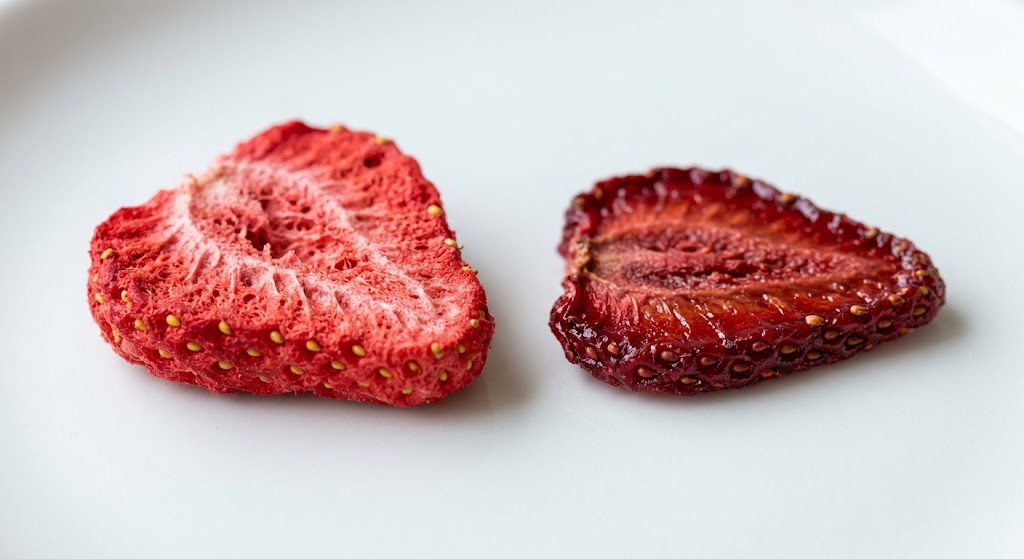 The main difference is how water is removed from the fruit.
Freeze-drying removes ice from frozen fruit through sublimation under vacuum. Conventional hot-air dehydration removes moisture by exposing fruit to heated air, which encourages water to evaporate. These different processes influence the structure and characteristics of the finished fruit.
How Freeze-Dried Fruit Is Made
Freeze-drying generally involves three main stages:
Freezing
Fresh or prepared fruit is frozen before drying.
Primary Drying
Under vacuum, ice is removed through sublimation without passing through the liquid phase.
Secondary Drying
Additional moisture is removed to reach the target moisture level required for the product.
Because the process operates at low product temperatures during much of the drying cycle, freeze-drying can help preserve the fruit’s original shape, color and characteristic aroma. The final product often has a lightweight, porous structure and a crisp texture.
Freeze-dried fruit is used in snack products, breakfast cereals, granola, chocolate inclusions, bakery applications and other foods where recognizable fruit pieces or a crunchy texture are desirable.
How Conventionally Dehydrated Fruit Is Made
Conventional dehydration commonly uses heated air to transfer heat to the fruit and carry moisture away. The fruit may be sliced or diced before drying to help achieve more consistent moisture removal.
Depending on the fruit and the process, manufacturers may also use pretreatments to control browning, texture or other quality characteristics.
Because the fruit is exposed to heat for an extended period, changes in color, aroma, flavor and texture can occur. The finished product is often denser and chewier than freeze-dried fruit, although the result varies considerably with the raw material and processing conditions.
Conventional dehydration is widely used for raisins, dried apricots, dried mango, banana products and other ingredients where a chewy texture is desirable.
2. Freeze-Dried Fruit vs Dehydrated Fruit: A Comparison for Buyers
For food manufacturers, the useful comparison is not simply which product is better. It is which ingredient best meets the technical and commercial requirements of the finished food.
| Evaluation Factor | Freeze-Dried Fruit | Dehydrated Fruit |
|---|---|---|
| Drying method | Freezing followed by vacuum sublimation | Commonly heated-air moisture removal |
| Typical texture | Light, porous and crisp | Often denser, softer or chewier |
| Shape retention | Often retains recognizable fruit structure | Depends on fruit type, cutting and drying |
| Color and aroma | Can retain color and characteristic aroma well | Heat may cause more noticeable changes |
| Rehydration | Porous structure can support rapid water uptake | Varies with density, thickness and processing |
| Ingredient cost | Generally higher processing costs | Often lower, depending on the product |
| Common applications | Crispy snacks, cereals, granola and inclusions | Chewy snacks, trail mixes and baked goods |
Buyer’s Note: These are general tendencies rather than guaranteed specifications. Actual performance depends on fruit variety, maturity, pretreatment, drying conditions, final moisture level and packaging. Supplier specifications and sample testing are more useful than relying on the drying method alone.
3. Which Method Better Preserves Fruit Color, Flavor and Structure?
Fruit quality depends on several factors, including the raw material, pretreatment, drying temperature, exposure time and storage conditions.
Freeze-drying can help retain the fruit’s characteristic color, aroma and shape because it removes water from frozen material under vacuum. Its porous structure also helps maintain a recognizable fruit-piece appearance.
This can be useful when fruit is a visible part of the finished product. For example, strawberry pieces in breakfast cereal or mango pieces in a snack mix need to look appealing as well as contribute flavor.
Conventional dehydration can also produce good-quality fruit ingredients. However, heat exposure may cause browning, aroma loss or texture changes, depending on the process and the type of fruit.
Neither method guarantees that every nutritional component will be preserved. The effect on vitamins, pigments and other compounds varies by nutrient and processing conditions.
For buyers, the best way to evaluate quality is to request representative samples and compare color, aroma, taste, texture and consistency against the requirements of the intended application.
4. How Do Texture and Rehydration Affect Food Applications?
Texture is one of the most important reasons manufacturers choose one drying method over another.
Breakfast Cereals and Granola
Freeze-dried fruit is often suitable for breakfast cereals and granola because its lightweight, crisp structure can provide a noticeable fruit component without introducing as much moisture as fresh fruit would.
However, freeze-dried pieces readily absorb moisture from their surroundings. If the finished product is exposed to humidity or has insufficient moisture-barrier packaging, the fruit may lose its crispness.
Buyers should evaluate the fruit in the actual cereal or granola formulation, including its performance during storage.
Snack Mixes and Ready-to-Eat Snacks
For snack brands, the choice depends on the desired eating experience.
Freeze-dried apple, strawberry or mango can provide a crisp bite and a lightweight texture. Conventionally dehydrated fruit may be more appropriate when the product is intended to be soft and chewy.
Manufacturers should also consider piece size, breakage during transportation, mixing conditions and the texture of the other ingredients.
Bakery and Chocolate Applications
Both freeze-dried and conventionally dehydrated fruit can be used in selected bakery products, confectionery and chocolate formulations.
Freeze-dried fruit pieces may be attractive when a crisp texture or visible fruit appearance is required. Fruit that is too moisture-sensitive, however, may soften or change texture after incorporation into certain formulations.
Conventional dried fruit may work better where a softer bite is desired. The best choice depends on the recipe, processing temperature, water activity and storage conditions of the finished food.
Rehydrated Foods and Food Ingredients
Freeze-dried fruit has a porous structure that can support water uptake, making it useful in applications where the fruit is rehydrated before consumption or processing.
Nevertheless, fast water uptake does not automatically mean that the fruit will recover its original fresh-fruit texture. Rehydration performance varies with fruit type, piece size, drying conditions and the temperature of the water.
If rehydration is a critical requirement, manufacturers should establish a test method and compare samples under the same conditions.
5. Which Option Is More Cost-Effective for Bulk Food Production?
Conventional dehydration often has a lower processing cost than freeze-drying. Freeze-drying requires specialized vacuum equipment, a freezing stage and a relatively long drying cycle.
However, comparing the purchase price per kilogram alone can lead to the wrong decision.
A buyer should consider the total cost of using the ingredient, including:
- Purchase price per kilogram.
- Moisture content and the amount of usable fruit solids.
- Required piece size and the percentage of broken pieces.
- Product performance during mixing, processing and storage.
- Packaging requirements and expected shelf life.
- Rejection rates, production losses and consistency between batches.
Consider the Finished Product, Not Just the Price
A snack manufacturer developing a premium product with visible fruit pieces may find that freeze-dried fruit better meets its quality requirements, even when the purchase price is higher.
A manufacturer producing a chewy fruit snack may find conventionally dehydrated fruit more suitable because its texture and cost structure align with the product.
The right comparison is therefore the cost per usable ingredient quantity and the performance achieved in the finished product, not simply the price per kilogram.
6. What Should Buyers Check When Sourcing Freeze-Dried Fruit?
Once a manufacturer decides that freeze-dried fruit is the right ingredient, the next step is to confirm the product specifications with the supplier.
Moisture Content and Water Activity
Moisture content measures the amount of water in a product. Water activity indicates how much water is available for microbial growth and certain chemical reactions.
These measurements are related but are not interchangeable. Buyers should specify the relevant requirements and request supporting test information where appropriate.
Fruit Format and Particle Size
Freeze-dried fruit may be supplied whole, sliced, diced or in smaller pieces, depending on the product.
The required format should match the intended application. Cereal producers may need uniform pieces for consistent distribution, while manufacturers of inclusions or blended ingredients may require smaller particle sizes.
Confirm the available dimensions, tolerances and acceptable level of broken pieces before placing a bulk order.
Ingredients and Pretreatment
Buyers should verify whether the product contains only fruit or includes other ingredients, such as added sugar or processing aids.
If a clean-label or single-ingredient formulation is required, confirm the ingredient declaration and any relevant processing details rather than assuming that every dried-fruit product has the same composition.
Packaging and Storage
Freeze-dried fruit is sensitive to moisture exposure. Suitable packaging helps protect the product during storage and transportation.
Ask the supplier about the inner packaging material, sealing method, outer carton, recommended storage conditions and validated shelf life.
After opening, the product should be resealed promptly and handled according to the supplier’s storage instructions.
Quality Documentation and Batch Consistency
For commercial production, buyers may need a product specification sheet, Certificate of Analysis (COA), microbiological results, allergen information and applicable food safety documentation.
The exact requirements depend on the product and destination market. Buyers should confirm the documentation needed for their own quality system and regulatory obligations.
7. How to Choose the Right Freeze-Dried Fruit Supplier
A suitable supplier should be able to provide more than a competitive quotation.
Before committing to a long-term order, buyers should evaluate the supplier’s ability to meet the product specification consistently.
Supplier Evaluation Checklist
- Can the supplier provide the required fruit varieties and formats?
- Are moisture limits, particle sizes and other specifications clearly documented?
- Can representative samples be evaluated before bulk production?
- Are quality control procedures and batch records available?
- Can the supplier explain packaging options and storage requirements?
- Are minimum order quantities, production lead times and export arrangements suitable for the project?
- Can the supplier provide the quality documents required for the destination market?
For repeat orders, it is also useful to agree on a product specification and sample approval process before production begins.
This reduces the risk of differences in texture, color, particle size or other characteristics between the approved sample and subsequent deliveries.
8. Why Work with a Freeze-Dried Fruit Manufacturer?
Working directly with a manufacturer can make it easier to discuss product specifications, sample development, packaging and supply requirements.
Fujian Lixing Foods manufactures freeze-dried fruit products in a range of formats, including whole fruit, slices, diced pieces and smaller pieces, depending on the product.
The company’s published product specifications include different particle sizes and packaging options. Buyers should confirm current availability, minimum order quantities and specifications for the particular fruit they need.
For food manufacturers, snack brands and ingredient distributors, the first step is to identify the intended application and define the product requirements. This makes it easier to evaluate samples and determine whether a particular freeze-dried fruit is suitable for commercial production.
Explore Freeze-Dried Fruit Products →
Frequently Asked Questions
Is freeze-dried fruit healthier than dehydrated fruit?
Not necessarily. Both can provide fruit ingredients, but their nutritional profiles depend on the fruit, processing conditions and any added ingredients. Freeze-drying can help retain certain heat-sensitive components, but it does not guarantee higher levels of every nutrient.
Does freeze-dried fruit last longer than dehydrated fruit?
Shelf life depends on the product’s moisture level, water activity, packaging, storage conditions and quality controls. Neither drying method guarantees a longer shelf life in every case. Buyers should follow the supplier’s validated shelf-life information.
Can freeze-dried fruit be used in breakfast cereals?
Yes. Freeze-dried fruit is commonly used in cereals, granola and other dry food products where a lightweight, crisp texture and recognizable fruit pieces are desirable. Packaging must protect the fruit from moisture to help maintain its texture.
Why is freeze-dried fruit more expensive?
Freeze-drying requires specialized equipment, vacuum processing and a controlled drying cycle. These factors generally increase processing costs compared with conventional hot-air dehydration. The actual price difference depends on the fruit, product format, order quantity and supplier.
What specifications should I request when buying bulk freeze-dried fruit?
Start with the fruit variety, ingredient composition, particle size, moisture content, packaging, shelf life and applicable microbiological requirements. Depending on the application, you may also need water activity data, allergen information, a COA and other quality documentation.
Can freeze-dried fruit be customized for food manufacturing?
Product formats, particle sizes and packaging may be available in different options, depending on the fruit and supplier’s production capabilities. Confirm the required specification, minimum order quantity, sample availability and lead time before ordering.
Conclusion
Choosing between freeze-dried fruit and conventionally dehydrated fruit comes down to the requirements of the finished product.
Freeze-dried fruit is often a strong option when a lightweight structure, crisp texture, recognizable fruit appearance or rehydration performance is important. Conventionally dehydrated fruit may be more appropriate when a softer, chewier texture and lower ingredient cost are the main priorities.
For food manufacturers, the most reliable approach is to define the application, compare product specifications and test representative samples before committing to a bulk order.
Sourcing Freeze-Dried Fruit?
Find the Right Fruit Ingredients for Your Production
Discuss fruit varieties, product formats, specifications and bulk supply requirements with Fujian Lixing Foods for your next food manufacturing project.