Freeze Dried Blueberry Powder for Beverages and Bakery: Color, Solubility, and Dosage Tips
12 月-22-2025
Quick Summary
Freeze dried blueberry powder is a premium fruit ingredient used to deliver authentic berry aroma and a natural-looking purple hue in beverages, bakery, dairy, and nutrition products. For commercial buyers, performance depends less on “fine powder” marketing and more on measurable controls: moisture and water activity, particle size distribution, color stability under heat and light, dispersion behavior (clear vs natural haze), and packaging barrier strength against humidity. This guide explains the specs that matter, how brands set dosage targets, and how to choose a supplier grade that stays consistent from pilot batches to full-scale production.
Why blueberry powder keeps winning in product development
Blueberry is one of those flavors that works in both “health” and “indulgence” positioning without sounding forced. In beverage mixes it reads clean and fruity. In bakery and dairy it feels familiar, premium, and easy to explain to consumers. Freeze dried blueberry powder adds another advantage: it gives brands a way to standardize berry taste and color without dealing with the variability and logistics of fresh fruit.
If your site is building a long-term ingredient library, it helps to anchor users with an internal learning page like the ultimate guide to freeze-dried fruit, then move them into format-specific pages once they understand the basics.
What “freeze dried blueberry powder” actually means in manufacturing terms
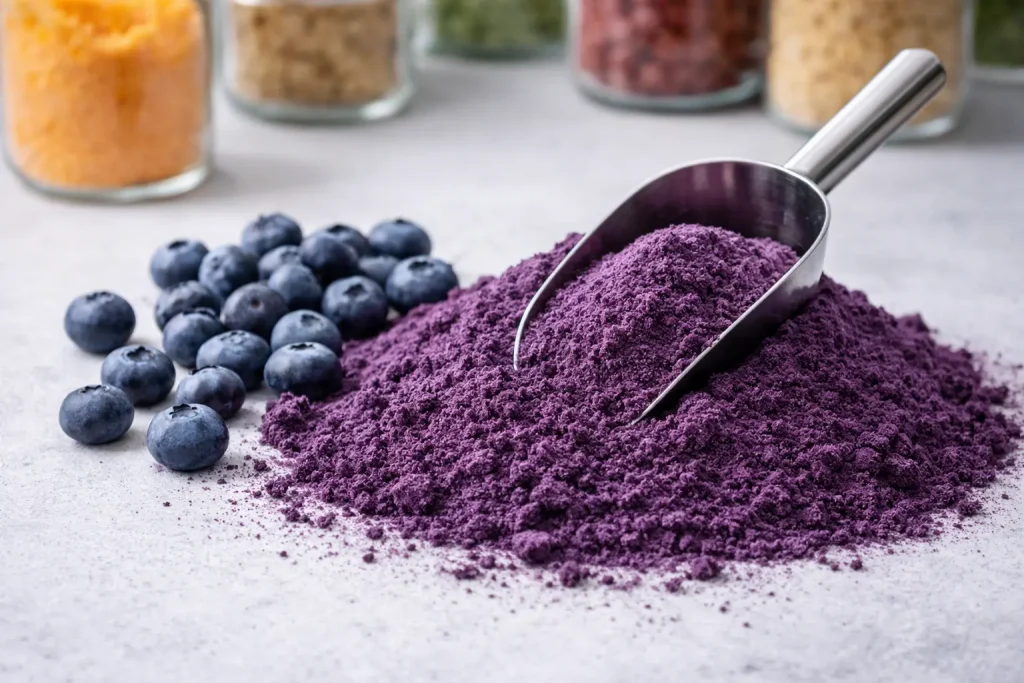
Freeze drying removes water at low temperature under vacuum, then the dried blueberry is milled into a controlled powder. The result is a porous structure that rehydrates quickly and releases aroma well, but also a structure that can pick up humidity quickly if packaging and storage are weak.
This is where many buyers get surprised. The powder can be excellent, but performance will collapse if it sits open in a humid room, or if it ships in packaging that allows moisture ingress.
If you want to give readers a credibility boost without sounding academic, a short reference to the origin of freeze-drying technology is an easy “authority” bridge.
The 5 specs that decide whether your blueberry powder performs or disappoints
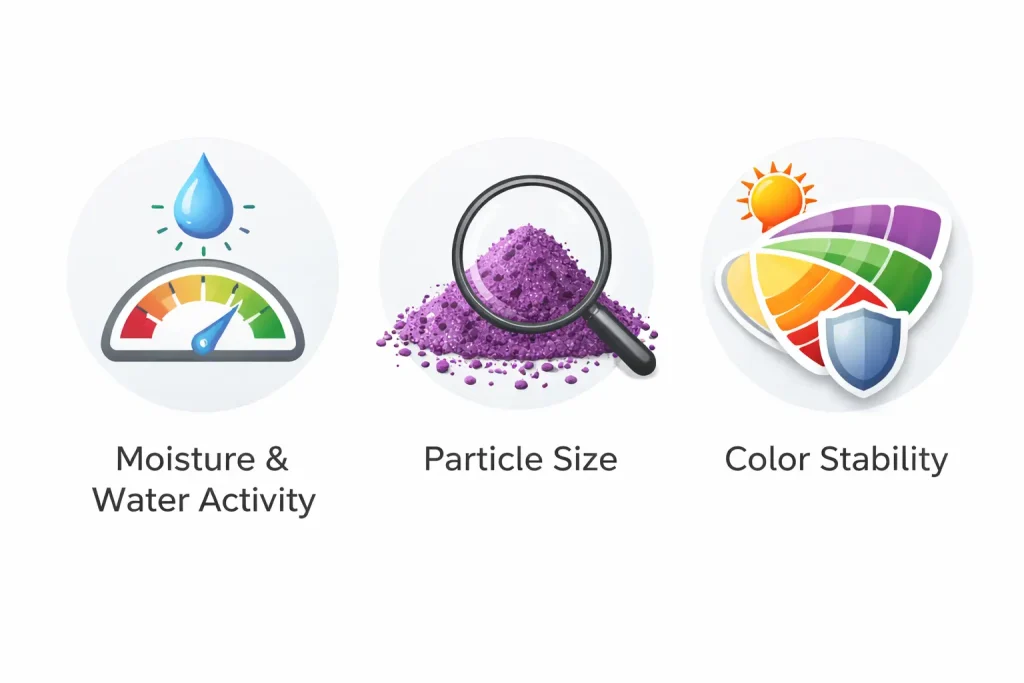
Moisture content and water activity
Moisture tells you how much water is present. Water activity tells you how available that water is to drive texture changes and microbial risk. In real production, water activity is often the better predictor of caking and shelf stability. If a supplier cannot provide water activity or only speaks in vague terms, that is usually a sign the program is not designed for demanding commercial use.
Particle size distribution
This is not just about “mesh.” Distribution affects dusting, mouthfeel, sedimentation, and how the powder behaves when mixed into liquids. A powder that is too fine can become messy on production lines and can clump on contact with moisture. A powder that is too coarse can feel gritty or settle.
What matters is consistency. The best buyer questions sound like this: what is the target distribution range, and how is lot-to-lot consistency controlled after milling and sieving?
Color stability under processing and storage
Blueberry color is often linked to anthocyanins. In simple terms, color can shift with heat, pH, light exposure, oxygen, and prolonged humidity. That means your final color in a bakery frosting can look different from your color in an acidic beverage. The “right” powder is the one whose color behavior matches your product environment.
A practical way to write this on-page is to advise buyers to test color in the intended matrix, not only “powder in a spoon.” That line alone saves people money and prevents complaint-driven returns.
Dispersion behavior and clarity expectations
Some products want a clear drink. Other products are fine with natural haze because it looks more “real fruit.” Blueberry powder can do either depending on how it is produced, how fine it is, and how it is mixed. A buyer who expects crystal clarity but formulates like a smoothie brand will be unhappy. Setting expectations in your article improves conversions because it filters the right customers.
Packaging barrier performance
Freeze dried powders are low-moisture and porous, which makes them humidity magnets. Good packaging is not a branding detail. It is part of product quality. If you sell multiple fruit powders, it is natural to route readers to your freeze-dried fruit powder options page after explaining why packaging and storage are critical, because that is the moment buyers start comparing formats.
How to choose dosage without guessing
Most buyers ask, “What dosage should we use?” The honest answer is: it depends on your sensory target, your base formula, and whether you want blueberry to be a top note or a background note. Still, there is a practical framework you can publish that feels helpful and professional.
Start by defining your target outcome in one sentence. Do you want “blueberry aroma on the nose,” “blueberry taste in the finish,” or “purple color with a light berry note”? Each target pushes dosage and particle size in a different direction.
Then test in small steps. Blueberry can intensify fast, especially in dry mixes. If you jump too high, you may get a slightly tannic edge or a color that looks too dark for your brand.
In beverages, mixing method matters. If the powder hits water all at once without dispersion control, it will clump and you will think the powder is low quality. In reality, it is a process issue. A better practice is to preblend the powder with another dry ingredient, then add with controlled agitation. That improves dispersion and sensory consistency.
Best use cases for freeze dried blueberry powder
Beverage mixes and RTD concepts
Blueberry powder works well in stick packs, smoothie bases, functional drink blends, and fruit-forward hydration products. If clarity matters, test your chosen powder in your exact pH environment and at both cold and ambient temperatures. If a natural haze is acceptable, you can lean into the “real fruit” positioning and focus more on aroma retention and humidity control.
Bakery and fillings
In bakery, freeze dried blueberry powder adds fruit flavor without adding liquid. That makes it useful for frostings, fillings, cookie dough, and layered desserts. Buyers should test for how the powder behaves in fat-based systems versus water-based systems, because color and perceived flavor can shift.
Dairy, yogurt, and nutrition products
Blueberry powder performs well in yogurt mixes, ice cream bases, protein blends, and nutrition bars. In cold products, aroma perception can reduce slightly, so brands sometimes adjust dosage or pair blueberry with complementary notes.
If you want to show a “neighbor product” that buyers often compare against for blending, linking to freeze-dried apple powder works naturally because apple is frequently used to round sweetness and soften sharp berry edges in formulations.
Common causes of clumping and how buyers prevent it
Clumping is usually humidity. Sometimes it is also electrostatic behavior from ultra-fine powders. The fixes are operational, not magical.
Humidity discipline after opening is the simplest improvement. Reseal quickly, keep powder away from steam and hot-fill zones, and use dry utensils. If the production environment is humid, buyers should use smaller pack sizes to reduce open-time exposure.
Packaging also matters. High barrier packaging reduces moisture ingress during shipping and storage, which protects crunch, aroma, and flowability.
How to evaluate suppliers without wasting weeks
A practical supplier evaluation is built around repeatability. A single “great sample” is not enough. Commercial buyers need consistency across lots.
Ask for lot-based test parameters. Ask how particle size is controlled. Ask what packaging barrier is used. Ask how the powder is protected from humidity after milling.
If you want a subtle internal navigation jump without pushing a specific SKU, rotating a neutral browse link such as another category page can keep users moving deeper into your site without turning your article into a sales page.
What to write on your website to reduce misunderstandings
The fastest way to reduce returns and improve inquiry quality is to be clear about two things: expected appearance in liquids and storage discipline after opening. Buyers appreciate a supplier who tells the truth upfront, because it makes their launch smoother.
You can also clarify that freeze dried powder is not automatically “clear” in drinks, and that a natural haze can be normal depending on fruit composition and particle size.
Conclusion
Freeze dried blueberry powder is a high-impact ingredient for beverage, bakery, dairy, and nutrition brands when it is purchased with the right specs and used with realistic expectations. The most reliable buying decisions focus on moisture and water activity, particle size distribution, color stability in the target product environment, dispersion behavior, and packaging barrier strength against humidity. When those controls are in place, blueberry becomes a predictable, scalable flavor and color tool rather than a source of production surprises.
Semantic Insight Loop
To make blueberry powder perform consistently, lock three variables first: moisture and water activity for shelf stability, particle size distribution for dispersion and mouthfeel, and barrier packaging for humidity defense. Then choose your dosage based on the product goal you want to win—aroma, taste, or color—because each goal pushes your formulation decisions in a different direction.
FAQ
1) What is freeze dried blueberry powder used for?
Freeze dried blueberry powder is used in beverage mixes, bakery fillings and frostings, yogurt and dairy blends, nutrition products, and snack formulations where brands want authentic berry aroma and a natural-looking color with precise dosing.
2) Why does blueberry powder sometimes clump after opening?
Clumping is usually caused by humidity pickup because freeze dried powders are porous and absorb moisture quickly. Fast resealing, dry handling, and high-barrier packaging reduce caking and improve flowability.
3) Does freeze dried blueberry powder dissolve completely in drinks?
Some powders disperse smoothly while others create a natural haze depending on particle size and fruit composition. Clear drinks require testing in your target pH and process conditions to confirm the visual outcome.
4) Which specifications matter most when buying freeze dried blueberry powder?
Commercial buyers typically prioritize moisture content and water activity, particle size distribution, color stability, microbiological limits, and packaging barrier strength because these determine shelf stability and performance in mixing.
5) How do I choose the right dosage for my formulation?
The best dosage depends on whether your priority is aroma, taste, or color. Brands usually test in small step changes inside the real product matrix, because perception shifts across beverages, bakery, and cold dairy applications.