How Japan Brands Choose Freeze-Dried Ingredients for Clean Taste, Precise Texture, and High-Standard QC
12 月-28-2025
How Japan Brands Choose Freeze-Dried Ingredients for Clean Taste, Precise Texture, and High-Standard QC
Japan doesn’t buy “ingredients.” They buy repeatable sensory performance—batch after batch, season after season.
Japan is one of the most demanding markets for freeze-dried fruits, vegetables, and powders—especially for brands building premium snacks, functional beverages, instant soups, and high-quality tea-based products. Buyers don’t just ask whether the ingredient is “natural.” They ask whether the flavour is clean, the aroma is stable, the texture rehydrates the right way, and the spec stays consistent at scale.
This article shows how Japanese brands typically evaluate freeze-dried ingredients, which tests matter most, and how to move from sampling to stable long-term supply without getting stuck in endless re-trials.

Why Japan’s Selection Logic Looks Different
Japan’s food R&D teams often operate with a “sensory-first” mindset, then validate with technical checks. A product can fail even if it is technically acceptable, because the market is sensitive to subtle defects like dull aroma, rough mouthfeel, uneven rehydration, or colour drift.
In practice, Japanese buyers usually care about these fundamentals: a clean finish (no “dusty” aftertaste), predictable rehydration texture, low variability across batches, and documentation that supports internal QA reviews. If a buyer wants to understand your manufacturing background and compliance readiness before they request samples, the most natural reference is your company profile on the About Us page.
Start With the Product System: Hot vs Cold
Japan’s applications split clearly into “hot systems” and “cold systems,” and the acceptance criteria change depending on where the ingredient will be used.
Hot systems include instant soups, noodle meals, porridge mixes, and hot-prepared bakery fillings. Cold systems include beverage powders, dairy blends, smoothies, and ready-to-mix drink concepts.
A simple decision map that mirrors how Japanese teams shortlist ingredients:
| System | Common Japan Products | Typical Format Choice | What “Pass” Looks Like |
|---|---|---|---|
| Hot | Instant soup, noodle cups, porridge | vegetable pieces / dices, some powders | fast rehydration + natural bite + stable colour |
| Cold | drink powders, dairy blends, smoothies | fruit powder, tea powder, fine inclusions | clean dispersion + low sediment + bright aroma |
If buyers are exploring your broad ingredient range first, guide them to Dried Foods. If the project is powder-driven, the most direct portfolio page is Freeze-Dried Fruit Powder.
Japan’s Core Applications and What They Test First
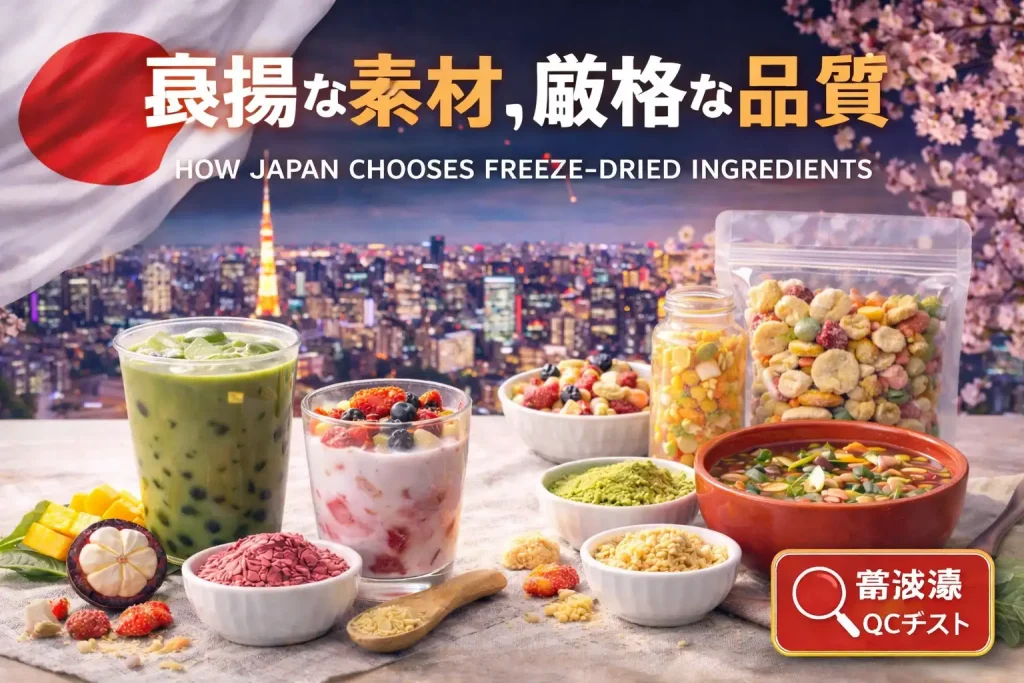
Premium Snacks and Better-For-You Formats
For snacks, Japan often values “real ingredient cues.” Freeze-dried fruits and vegetables work well because they provide natural flavour and light texture while keeping formulations clean and controllable.
What buyers test first is not only taste. They check how the ingredient behaves after storage: whether aroma stays fresh, whether the piece integrity remains attractive, and whether the product still feels “crisp” or “light” rather than stale.
A practical product example to anchor discussions is a familiar powder that behaves predictably in blends, such as Freeze-Dried Corn Powder, which many teams use as a benchmark for dispersion and lot consistency.
Instant Soups and Convenience Meals
Japan’s convenience food market is mature. Consumers expect speed and sensory quality at the same time, which makes rehydration performance the deal-breaker.
For soup-style concepts, it’s helpful to reference the application value of freeze-dried inclusions through a relevant educational page like Freeze-Dried Vegetable Soup Packets. If noodles are part of the product roadmap, this knowledge reference fits naturally: The Difference Between Freeze-Dried and Instant Noodles.
Beverage Powders, Dairy Blends, and Smooth Systems
Japan’s beverage products often require extremely clean taste and controlled mouthfeel. When powders don’t disperse smoothly, or when sediment increases after standing, a product can fail internal panels quickly.
This is where both fruit powders and tea powders become central. If the buyer’s concept is tea-led, a concrete example is Spray-Dried Oolong Tea Instant Powder, and the broader range can be browsed under Tea & Plant Extract Products.
Premium Fruit Inclusives and High-End Presentation
Japan also values visual and seasonal presentation. Freeze-dried fruits can support premium “seasonal” formats where the ingredient must look and taste authentic.
Citrus is a common direction in Japan, so this reference can be used naturally when discussing beverage and dessert applications: Uses of Freeze-Dried Lemon Slices. For more exotic fruit options, a category-relevant example is Freeze-Dried Mangosteen, which aligns with premium sensory positioning.
The “Japan Standard” Test Set
Japanese teams tend to run fewer tests, but they run the right tests—aligned to the real product system.
For cold systems, the first pass is dispersion (how fast and how clean), followed by sediment after standing, then aroma stability after storage. They often evaluate mouthfeel carefully, because even slight powder roughness can reduce perceived quality.
For hot systems, rehydration timing matters more than almost anything. They test texture at realistic preparation times and temperatures. If the ingredient needs six minutes but the product instructions say three, it will fail in the real world.
Across both systems, Japan heavily values lot-to-lot repeatability. Many suppliers lose here: the first sample is great, but the second batch behaves differently. Japan’s QA teams will notice.
If a buyer asks about storage stability questions, a practical supporting reference is Shelf Life of Dried Fruits.
Expert Insights
A beverage formulator’s view: Japan’s consumers notice texture. A powder that disperses quickly but leaves a gritty mouthfeel can still fail, because premium positioning requires a clean finish and stable sensory identity.
A convenience-food developer’s view: rehydration is the brand promise. If vegetables rehydrate unevenly, or the bite feels off, the entire product feels “cheap,” even if the flavour is good.
A quality manager’s view: consistency is the fastest path to approval. When documentation is clear and the ingredient behaves the same across batches, internal review cycles shorten and new SKUs launch faster.
A Practical Shortlist Workflow That Avoids Re-Trials
A workflow that fits Japan’s pace is straightforward:
Brands define the product system and target sensory profile, then request only the formats that match those conditions. They run a small set of decisive tests, and if the ingredient passes, they move quickly into pilot-scale validation.
When buyers need application-focused guidance first, your Knowledge section is a clean educational destination. When they are ready to request specs, samples, and production details, direct them to Contact Us.
Conclusion
Japan chooses freeze-dried ingredients with a sensory-first, verification-driven process. The most reliable path is to start with the real product system (hot or cold), match the format (pieces or powder), and validate the few tests that predict consumer experience—rehydration texture for hot systems, dispersion and sediment behaviour for cold systems, plus aroma stability and batch repeatability for everything. When those fundamentals are locked, Japanese buyers don’t just approve an ingredient—they build long-term products around it.
FAQ
What is the first thing Japanese buyers evaluate in freeze-dried ingredients?
They usually start with sensory clarity—clean taste, stable aroma, and a natural finish—then validate performance in the real product system.
Why is rehydration texture so important for Japan’s instant foods?
Because consumers expect fast preparation and high quality at the same time, so texture must match the intended eating experience within realistic time limits.
For beverage powders, what causes rejection most often?
Poor dispersion, excessive sediment after standing, or a rough mouthfeel that reduces perceived quality.
How do buyers decide between fruit pieces and fruit powder?
Pieces are chosen for visible inclusions and texture cues, while powders are chosen for uniform flavour delivery and predictable processing.
Why does lot-to-lot consistency matter more in Japan?
Internal QA systems are designed to detect variability, and brands want confidence that approved performance remains stable over time.
What information helps suppliers recommend the right spec quickly?
The application type, hot or cold preparation, target flavour intensity, preferred particle behaviour (cut size or powder fineness), and expected storage conditions.
Where can buyers learn more before requesting samples?
They can review application references in Knowledge and then contact the supplier through Contact Us for specifications and sample planning.