Freeze Dried Durian for Global Markets: Slice vs Powder, Aroma Control, and Product Positioning
12 月-22-2025
Quick Summary
Freeze dried durian is purchased mainly in two commercial formats—slices and powder—because they solve different business problems. Slices sell “premium snack identity” and visual impact, while powder delivers controlled dosing for bakery, dairy, and beverage systems where aroma needs to be consistent and scalable. The most important specs are moisture and water activity, aroma retention, particle size (for powder) or breakage rate (for slices), microbiological limits, and high-barrier packaging that controls humidity and odor migration during shipping. This guide explains how buyers select the right format, how to reduce odor complaints without weakening flavor, and how to position durian products for different global markets.
Why freeze dried durian is a “love it or buy it again” category
Durian is not a “maybe.” Buyers either want the real thing, or they run away. That polarity is exactly why freeze dried durian can work so well commercially: the audience segment is clear, brand loyalty is high, and the product has a built-in premium story. The challenge is controlling aroma in logistics and setting correct expectations for different markets.
If your site needs a general knowledge entry for buyers new to freeze-drying, it helps to reference the ultimate guide to freeze-dried fruit and then direct serious buyers into durian-specific pages.
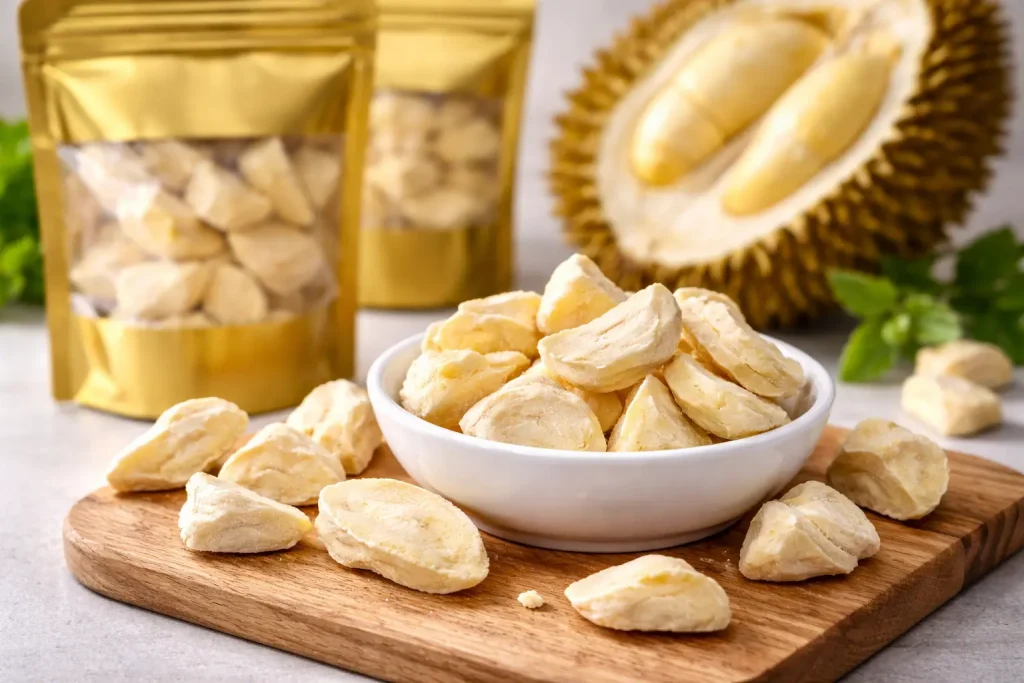
Slice vs powder: what they are really buying
“Slice or powder” is not just a shape choice. It changes who your customer is, how your product gets used, and what quality problems you will face.
When freeze dried durian slices are the best choice
Slices are the format for snack identity. They are sold as a premium snack, a gifting item, or an ecommerce product where customers want to see and recognize durian immediately. Slices also work for “experience-driven” products where visual storytelling is part of the value.
For buyers building a durian snack line, it is natural to guide them toward a dedicated product page like freeze-dried durian slices once they understand how the format affects shipping and shelf performance.
When freeze dried durian powder is the best choice
Powder is the format for controlled dosing. It is used when manufacturers want durian aroma and flavor in bakery mixes, ice cream bases, dairy applications, fillings, beverage blends, and nutrition products. Powder lets buyers standardize taste, which is critical when durian supply quality varies seasonally.
A natural next step for B2B buyers is a product page like freeze-dried durian powder, because powder buyers almost always ask for specs, packaging options, and standardization control.
The specs that decide if your durian program scales or collapses
Durian is not forgiving. If you don’t control the right variables, you will get two classic complaints: “it lost crunch” or “the smell leaked.”
Moisture content and water activity
Freeze dried products are stable until they absorb humidity. Low moisture and low water activity support crunch and shelf stability, but the real-world outcome depends on packaging barrier strength and how buyers handle the product after opening. If you publish one clear storage sentence, make it this: durability is won by humidity control, not by “hoping the warehouse is dry.”
Aroma retention (and why your packaging matters more than you think)
Durian aroma is the product. If it becomes weak, the customer feels cheated. If it leaks into surrounding cargo, your logistics partner will hate you. That’s why high-barrier packaging should be treated as part of product quality, not as a packaging cost.
You can support storage education with your internal content such as how long dried fruits last in a freezer, while clarifying that odor migration is a special issue for durian and requires stronger packaging discipline.
Breakage rate for slices and particle size for powder
For slices, breakage rate becomes a hidden margin leak. If the product arrives crushed, your snack SKU becomes “durian dust,” and the consumer will call it low quality.
For powder, particle size distribution controls dispersion, mouthfeel, dusting, and process handling. Buyers should request a consistent target range and ask how it is controlled after milling.
Microbiology and foreign matter controls
Durian often goes into ready-to-eat snack and dessert products. Buyers need lot-based microbiological parameters and foreign matter controls. This should be a standard part of any serious commercial durian program.
Aroma control without weakening the product
Buyers often ask for “less smell.” The trick is to control where the smell goes, not to remove it from the product.
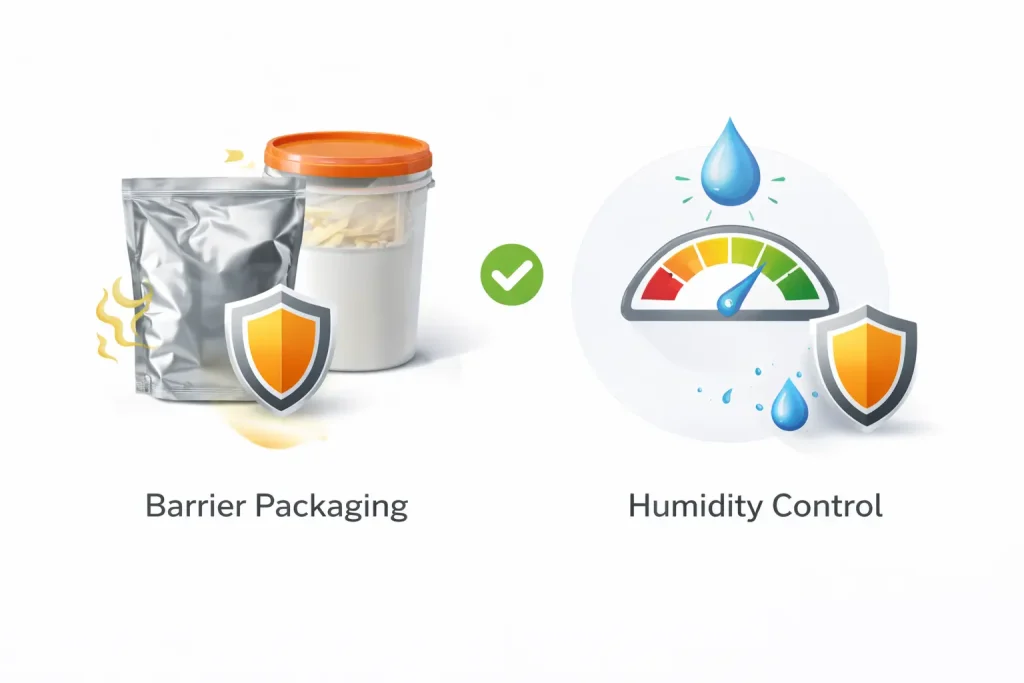
Use barrier packaging to stop odor migration
Odor migration is usually packaging permeability plus imperfect seals. High-barrier laminates, correct sealing standards, and controlled headspace are common solutions. For bulk buyers, lined pails or drums can reduce odor spread in warehouses.
Control humidity to protect texture
When slices absorb moisture, they soften and their aroma release changes. The consumer experiences that as “not fresh,” even if the product is safe. Strong humidity defense keeps crunch, which keeps the premium experience.
Set expectations by market
In Southeast Asia, durian aroma is often expected to be strong. In markets where durian is still “new,” buyers may prefer a more controlled aroma experience through powder-based applications like bakery or ice cream, where the aroma is integrated rather than “in your face.”
Product positioning: where durian wins in different markets
Durian’s global demand is not uniform. Smart positioning is about aligning format to buyer psychology.
Snack packs and ecommerce bundles
Slices win here because they are visually recognizable and “authentic.” Premium packaging supports the gifting angle and improves first-time trial conversion.
Bakery and dessert manufacturing
Powder wins here because it delivers consistent flavor with controlled dosing. This is often the easiest entry for markets that are still exploring durian, because the durian note feels integrated.
Beverage blends and café menu innovation
Powder can be used in shakes, dessert drinks, and specialty blends. If your site also pushes fruit tea concepts, you can keep users exploring by linking to a themed page like freeze-dried fruit tea options, because durian buyers frequently cross-shop other fruits to build assortments.
A buyer checklist that avoids the most common durian sourcing mistakes
Before you place an order, confirm these five points
-
moisture and water activity targets with lot-based testing
-
packaging barrier specification and odor migration control approach
-
slice breakage rate or powder particle size distribution targets
-
microbiological limits and foreign matter controls
-
storage and handling SOPs after opening for humid environments
What information buyers should send to speed up quoting
Buyers should specify format (slices or powder), target application (snack, bakery, dairy, beverage), preferred packaging (high-barrier bag, carton, pail), and the target shipping lane (because humidity and logistics handling differ by region).
If a buyer wants to compare “durian as ingredient” versus “durian as snack,” you can also route them to your main durian product page like freeze-dried durian as a neutral hub.
Conclusion
Freeze dried durian scales best when you match the format to the customer and control aroma and humidity with the same seriousness you control taste. Choose slices for premium snack identity and visual storytelling, and choose powder for controlled dosing in bakery, dairy, and beverage systems. The most reliable purchasing decisions focus on moisture and water activity, aroma retention and odor migration control, breakage rate or particle size distribution, microbiological limits, and high-barrier packaging that survives global shipping. When those variables are locked, durian becomes a repeat-buy category rather than a risky experiment.
Semantic Insight Loop
To make durian commercially predictable, treat “aroma control” as a packaging and logistics design problem, not a flavor-reduction problem. Lock moisture and water activity for crunch stability, then choose format based on buyer psychology: slices sell authenticity, powder sells scalability. Standardize breakage rate or particle size as contractual specs so every shipment behaves the same in storage and production.
FAQ
1) Is freeze dried durian better as slices or powder for commercial products?
Slices are better for snack packs and premium gifting because they show the authentic durian form, while powder is better for bakery, dairy, and beverage manufacturing because it enables controlled dosing and consistent flavor.
2) Why does freeze dried durian sometimes lose crunch during storage?
Crunch is lost mainly because the porous durian absorbs humidity through weak packaging or improper resealing after opening. High-barrier packaging and humidity discipline protect texture stability.
3) How can I reduce odor leakage in freeze dried durian shipments?
Odor leakage is usually solved with stronger barrier packaging, reliable heat-sealing standards, and protective secondary packing such as cartons or lined pails that reduce odor migration during transport.
4) What quality specifications should I request when buying freeze dried durian?
Buyers typically request moisture content and water activity, aroma retention indicators, microbiological limits, packaging barrier specifications, and either slice breakage rate or powder particle size distribution depending on the chosen format.
5) What are common applications for freeze dried durian powder?
Freeze dried durian powder is commonly used in ice cream bases, bakery fillings, dessert mixes, dairy blends, beverage formulations, and nutrition products where consistent flavor dosing is required.