Freeze Dried Fruit Powder: Specs, Uses, and Buyer Checklist for Brands
12 月-22-2025
Quick Summary
Freeze dried fruit powder is a premium ingredient format made by freeze-drying fruit and milling it into controlled particle sizes. For commercial buyers, the real differentiators are moisture and water activity, color and aroma retention, particle size distribution, microbiological limits, and packaging that prevents humidity pickup. This guide explains specs that matter, how brands use fruit powders in beverages, bakery, dairy, and seasonings, and a buyer checklist to size the right product grade for consistent taste and stable shelf life.
What freeze dried fruit powder is and why it sells
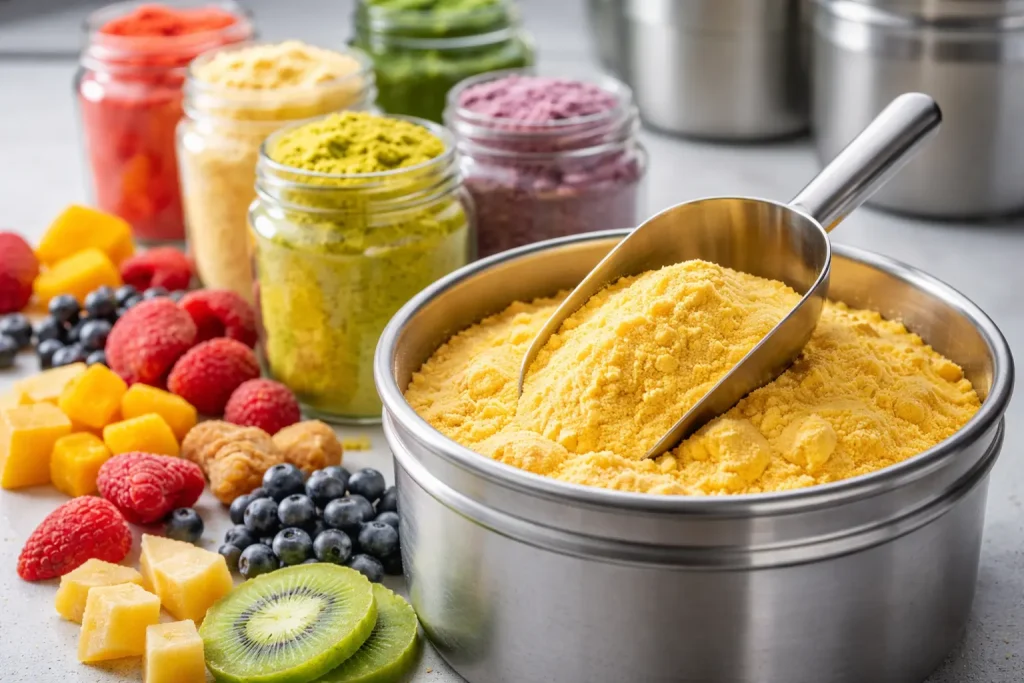
Freeze dried fruit powder is exactly what it sounds like—real fruit that has been freeze-dried first (to remove water at low temperatures) and then milled into a fine powder. The reason it keeps winning in modern product development is simple: you get concentrated fruit aroma and color with a clean label feel, while keeping formulation flexible. Instead of handling fresh fruit (short shelf life, messy prep, variable sweetness), brands can dose a powder precisely and repeatably.
If your site is building a “powder-first” product line, it helps to anchor readers with a broader learning page such as an internal <a href=”https://www.lixingfdfoods.com/news/the-ultimate-guide-to-freeze-dried-fruit”>ultimate guide to freeze-dried fruit</a> and then bring them back into your powder catalog pages when they’re ready to evaluate specific options.
The formats buyers confuse (and how to explain the difference)
Fruit powders fall into several families, and mixing them up is where specs and expectations go sideways.
Freeze dried fruit powder vs spray-dried fruit powder
Freeze dried powder usually retains a more “true fruit” aroma profile because it avoids higher-heat exposure. Spray-dried fruit powders often require carriers (like maltodextrin) to flow better, which can reduce flavor intensity per gram and change labeling. That doesn’t make spray-dried “bad”—it can be excellent for instant beverage systems—but it’s a different tool.
If you also run tea/coffee instant systems on your site, it’s easy to cross-reference an instant format product page (for example, <a href=”https://www.lixingfdfoods.com/products/instant-tea/instant-tea-powder-concentrates/spray-dried-oolong-tea-instant-powder.html”>spray-dried oolong tea instant powder</a>) so readers understand where spray-drying shines: speed, solubility, and standardized extraction.
Powder vs dice/cubes vs slices
Powder is for dosing, mixing, and blending. Dice/cubes are for texture and visual inclusions (granola, chocolate bars, cereal). Slices are for snack packs and premium “whole fruit” storytelling. The best-performing brands often build a range: one hero fruit in multiple shapes, each mapped to a different application.
The spec sheet that actually matters (and what to request)
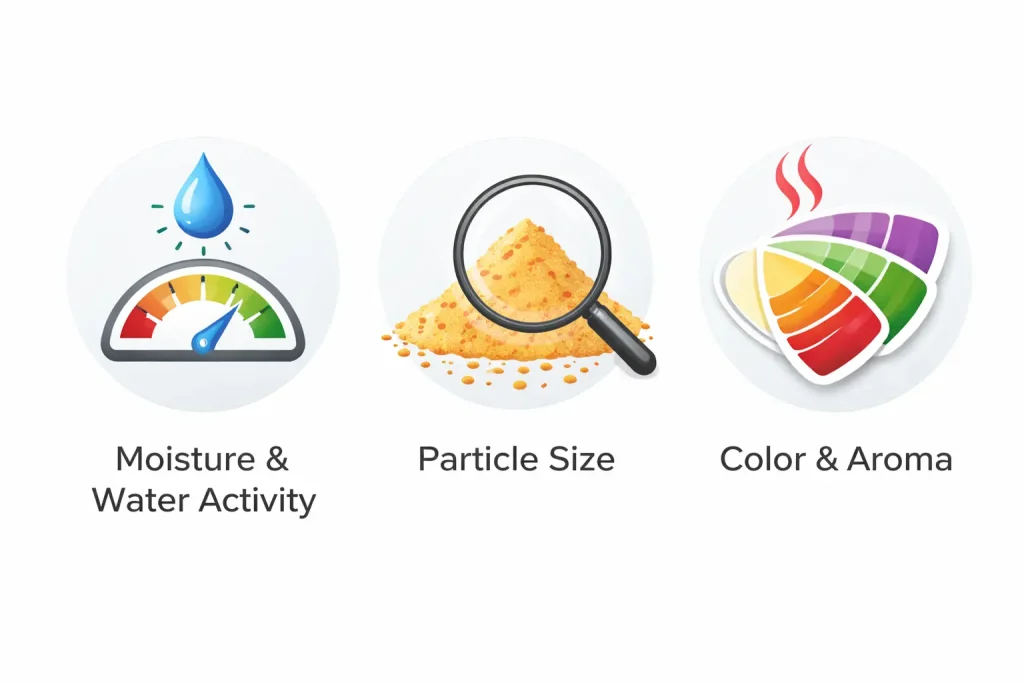
Most buyers waste time arguing about “fine” versus “extra fine.” The better question is: what specs keep your product stable, repeatable, and compliant?
Moisture content and water activity
Two different metrics, both critical:
-
Moisture content tells you how much water is present.
-
Water activity (Aw) tells you how available that water is for microbial growth and texture changes.
For shelf life and flowability, low Aw is your friend. Powders that pick up humidity will cake, lose aroma impact, and become inconsistent in mixing. If your supplier only quotes moisture and can’t provide Aw, that’s a red flag for serious commercial applications.
Particle size distribution (not just “mesh”)
Mesh or micron targets are useful, but distribution is what controls mouthfeel and mix behavior. Too many ultra-fines can cause dusting and static; too many coarse particles can cause sedimentation or gritty texture, especially in RTD beverages.
Ask for:
-
target micron range
-
distribution curve (or at least D10/D50/D90 if available)
-
whether sieving is used post-milling
Color stability and aroma profile
Freeze dried powders can look incredible—until humidity and oxygen do their thing. Color loss is often a storage/packaging problem, not a processing problem.
Request:
-
color reference (photo under standardized lighting or lab Lab* values if available)
-
packaging barrier details (foil laminate vs standard plastic)
-
storage recommendations based on humidity conditions
Microbiology and foreign matter controls
If your powder goes into ready-to-eat applications (snacks, drink mixes, yogurt toppers), microbiological limits matter. Your exact targets depend on your market, but your content should nudge buyers to ask the right question: “What are the lot-based test parameters and what sampling method is used?”
Also request:
-
metal detection specs
-
foreign matter control process
-
allergen handling practices (if applicable)
Where freeze dried fruit powder performs best
This is the part that drives buyer intent because it links the ingredient to real product outcomes.
Beverages: smoothies, RTD, functional drinks, tea blends
Powders are perfect for fast flavor dosing, especially in dry mixes and stick packs. In RTD beverages, the trick is hydration and dispersion: some fruits dissolve “cleaner,” some create natural haze, and some sediment if you push concentration too high.
A practical approach:
-
use a pre-blend with sugar or a compatible dry base
-
hydrate with controlled shear (not just dumping into cold water)
-
test at both cold and warm temperatures because consumer behavior varies
If you already publish fruit tea content, it’s natural to support a beverage-focused paragraph with a contextual internal link like your <a href=”https://www.lixingfdfoods.com/freeze-dried-fruit-tea/2022-hot-style-freeze-dried-fruit-tea-most.html”>freeze-dried fruit tea selection page</a> to keep users browsing without breaking the reading flow.
Bakery: cakes, cookies, fillings, frostings
Freeze dried powder gives you fruit intensity without adding liquid that disrupts batter ratios. It’s especially useful in buttercreams and fillings where water can cause separation.
What bakers care about:
-
flavor impact per gram
-
color in fat-based systems (frosting behaves differently than sponge cake)
-
whether the powder attracts moisture and softens crisp textures
Dairy: yogurt, ice cream, protein blends
In yogurt, powders are used for both flavor and marketing (“real fruit”). In ice cream, they can add color and aroma, but you need to test how the powder behaves during freezing and thawing—some fruits can shift sensory perception when cold.
Confectionery and snacks: coatings, bars, “better-for-you” lines
Powder can be dusted on candy, used in chocolate inclusions, or blended into bar matrices. The key is moisture protection: powders can pull water from the environment and cause sticky surfaces if packaging isn’t strong.
If your site builds snack innovation stories, one light internal jump like <a href=”https://www.lixingfdfoods.com/news/freeze-dried-marshmallows-an-innovative-crunchy-snack”>freeze-dried marshmallows</a> can help keep users exploring adjacent concepts without forcing them into a product page too early.
Formulation tips that prevent the most common failures
Most “powder problems” are actually mixing and storage problems. Here’s how to write this section so it reads like real manufacturing experience, not generic marketing.
Prevent clumping and caking
Caking is usually humidity uptake plus insufficient barrier packaging after opening. For commercial kitchens and factories, the best practice is a “use window” plus reseal discipline:
-
reseal immediately
-
avoid scooping with wet utensils
-
keep powders away from steam lines and hot-fill zones
Get predictable flavor intensity
Don’t chase “stronger powder” first—chase consistent dosing. Two lots can taste different if fruit maturity and harvest conditions differ, so your SOP should include small pilot checks on every new lot for critical SKUs.
If you’re selling multiple fruit powders, you can route readers to a range page like <a href=”https://www.lixingfdfoods.com/products/freeze-dried-fruit-powder.html”>freeze-dried fruit powder options</a> while encouraging them to standardize two or three core powders before expanding the SKU list.
Choose the right powder for the job
A fine powder can be perfect for drink mixes but annoying in open production due to dusting. A slightly coarser powder may improve handling and reduce airborne loss. This is why “one universal mesh” rarely works across every application.
Packaging and storage: the difference between stable product and expensive dust
Freeze dried powders are low-moisture, which makes them stable—until they absorb humidity. Your content should be blunt here: poor packaging is a silent margin killer.
Packaging that buyers should request
Commercial buyers typically choose between:
-
high-barrier foil laminates for premium aroma protection
-
multi-layer bags inside cartons for logistics stability
-
food-grade pails/drums with liners for large-volume factory use
You can reinforce storage education with a natural internal reference like <a href=”https://www.lixingfdfoods.com/news/how-long-can-dried-fruits-last-in-freezer”>how long dried fruits last in a freezer</a>, but clarify in your writing that powders behave differently from whole pieces because surface area increases humidity risk.
Storage rules that reduce returns
-
keep in a cool, dry warehouse
-
control humidity (this matters more than temperature for powders)
-
rotate stock with FIFO
-
avoid storing near strong odors (powders can pick up aroma over time)
A buyer checklist for commercial procurement teams
If you want inquiries, this section matters. It turns your article into a procurement tool.
Questions to ask before ordering
-
What are the moisture and water activity targets, and are they tested per lot?
-
What particle size distribution is provided, and how is consistency controlled?
-
What are the microbiological standards and the testing frequency?
-
What is the packaging barrier specification and recommended storage humidity?
-
What is the typical lead time and how are samples matched to production lots?
What to send your supplier to speed up quoting
The fastest sourcing happens when buyers provide:
-
application type (beverage, bakery, dairy, snack)
-
desired sensory outcome (color-forward, aroma-forward, “natural fruit note”)
-
any restrictions (no carriers, organic, clean label positioning)
-
target pack size and annual volume estimate
A practical example: turning one powder into three product lines
Imagine you’re launching a fruit-forward beverage brand. With one core powder (say apple or mango), you can create:
-
a stick-pack drink mix
-
a smoothie base for foodservice
-
a bakery collaboration SKU (cookies or frosting mix)
That’s why product developers love powders: one ingredient supports multiple revenue channels.
If apple is one of your workhorse flavors, it’s useful to give readers a direct path to a specific product page such as <a href=”https://www.lixingfdfoods.com/products/freeze-dried-apple-powder.html”>freeze-dried apple powder</a> right after you describe applications, because that’s exactly when they start thinking, “Ok, what’s the spec and how do I buy it?”
Common misconceptions that hurt rankings and conversions
“All fruit powders are the same”
They aren’t. Even with the same fruit name, different harvest windows, different milling targets, and different packaging standards create meaningful differences in performance.
“If it’s freeze dried, it’s automatically better”
Freeze drying is a powerful method, but the commercial outcome depends on process control and post-processing handling. A great powder can be ruined by poor humidity control after milling.
“Powder means it must dissolve fully”
Not always. Some powders are designed to create natural haze or fruit body, not crystal-clear solutions. Your content should set correct expectations to reduce complaints.
Conclusion
Freeze dried fruit powder is one of the most efficient ways to deliver real-fruit flavor and color across beverages, bakery, dairy, and snack manufacturing. The buyers who succeed don’t just compare fruit names—they compare moisture and water activity, particle size distribution, microbiological controls, and packaging barriers that protect the powder from humidity. If you align the powder grade to the application and build a simple lot-check process, you get stable production, repeatable taste, and fewer quality surprises.
Semantic Insight Loop
If your goal is faster product development and fewer stability issues, treat fruit powder like a controlled ingredient system: define the application first, then lock moisture/Aw targets, particle size distribution, and barrier packaging. From there, build a small “core powder set” (2–3 fruits) and expand into slices or cubes only after your powder SKUs prove consistent in production and shipping.
FAQ
1) What is freeze dried fruit powder used for in commercial production?
Freeze dried fruit powder is used to add fruit flavor and natural-looking color in dry mixes, beverages, bakery fillings, frostings, yogurt blends, ice cream bases, seasonings, and snack coatings—especially where brands need precise dosing and repeatable results.
2) What specifications matter most when buying freeze dried fruit powder?
Commercial buyers typically focus on moisture content and water activity, particle size distribution, microbiological limits, and packaging barrier performance, because these directly affect shelf stability, flowability, and consistency in mixing.
3) Does freeze dried fruit powder dissolve completely in drinks?
Some freeze dried powders disperse well and dissolve smoothly, while others create a natural haze or slight sediment depending on fruit type and particle size. For RTD applications, pre-blending and controlled hydration usually improves dispersion and reduces clumping.
4) How should freeze dried fruit powder be stored after opening?
After opening, the powder should be resealed quickly, protected from humidity and steam, stored in a cool dry area, and used within a defined internal “use window” to prevent caking and aroma loss.
5) How do I choose the right particle size for my application?
Finer powders generally suit drink mixes and smooth textures, while slightly coarser powders can reduce dusting and improve handling in factory environments. The best choice depends on whether your priority is solubility, mouthfeel, or production efficiency.