How Japanese Brands Choose Freeze-Dried Fruit for Clean, Delicate Flavour Profiles
12 月-28-2025
How Japanese Brands Choose Freeze-Dried Fruit for Clean, Delicate Flavour Profiles
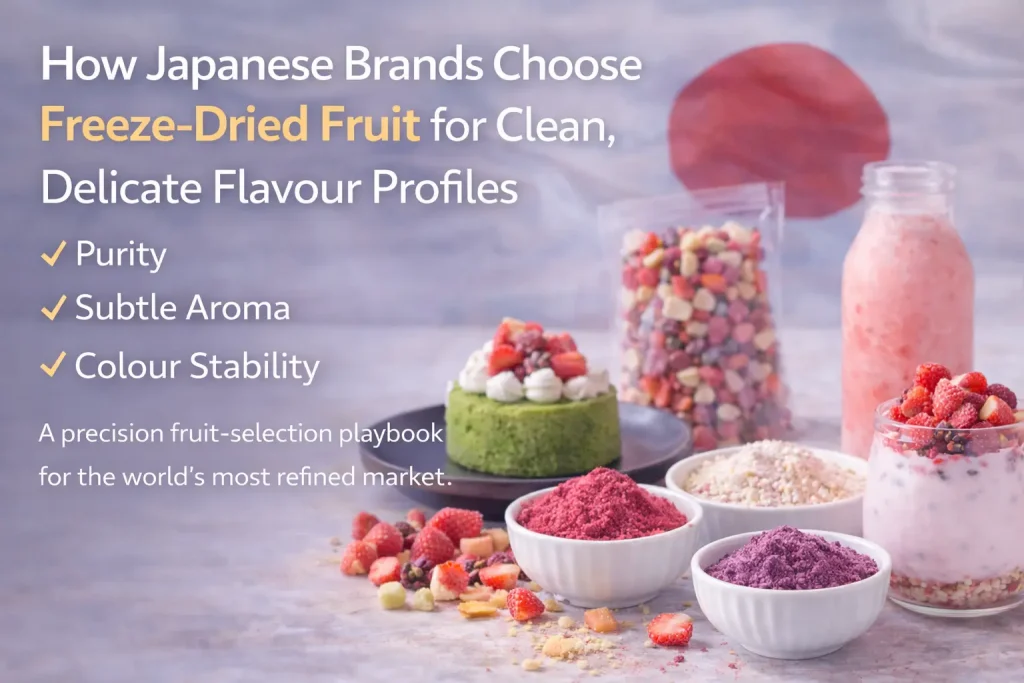
From matcha desserts to bottled drinks, Japan prioritises purity, subtle aroma, and colour stability—so choosing the right freeze-dried fruit is a precision decision, not a guess.
What Makes the Japanese Market So Strict About Fruit Ingredients
Japan is a market where consumers notice the small things. A fruit note that feels “too loud” can be rejected as artificial. A colour shift that looks slightly dull can lower perceived quality. A powder that clumps in a beverage base can create a negative mouthfeel even if the taste is fine. That is why Japanese buyers often evaluate freeze-dried fruit the way engineers evaluate a component: the ingredient must deliver consistent results inside a very specific product style.
In Japan, freeze-dried fruit is commonly used to support clean-label, “real fruit” positioning in products where the fruit character must be elegant rather than aggressive. This includes fruit-forward yoghurts, confectionery, seasonal desserts, powdered drink blends, and premium snack lines that compete on refinement. In these categories, the selection process usually starts with one decision: should the product use visible fruit pieces, fine granules, or a powder format.
If a buyer wants to browse options by category before choosing format, the simplest starting point is the dried-food collection on your site, which keeps the conversation focused on ingredient outcomes rather than marketing promises: Dried Foods.
Step One: Choose the Format Based on the “Japanese Texture Expectation”
Japan’s texture expectations are especially demanding. Many products must feel clean in the mouth, with no gritty after-feel, no unexpected chewiness, and no random hard bits that disrupt the experience. This is why Japanese buyers often match format to the exact eating moment.
Visible slices or larger pieces are typically used when the product wants a premium visual cue—such as dessert toppings, gift-style snacks, and seasonal limited editions. Smaller diced pieces and granules are common in baked products where the fruit needs to distribute evenly, while powders are widely used in beverages and confectionery where consistent flavour per serving matters more than visible pieces.
The key is that the format must support the product’s “finish.” If the product is designed to taste clean and light, the fruit inclusion should not introduce messy texture or inconsistent distribution.
What Japanese Buyers Test First
Even before a formal sample approval, Japanese product teams tend to run a fast evaluation loop. They are not only judging whether the fruit tastes good. They are judging whether it behaves correctly inside the intended product.
Aroma Purity: Subtle but Real
Japanese products often aim for “natural elegance.” Buyers will smell-test the ingredient both as-is and after being blended into the base. They look for aroma that is clear, fresh, and recognisable—without any candy-like notes or harsh edges.
In practice, this means the fruit cannot depend on heavy sweetness to feel “fruity.” The aroma itself must carry authenticity. If the aroma collapses after mixing, the fruit will be seen as weak and may fail the first screening.
Colour Fidelity: “Beautiful” Must Stay Beautiful
Colour matters strongly in Japan. If the fruit inclusion looks faded or shifts toward brown in real application, the product can look tired even when it is new. For many Japanese categories, colour is part of the premium signal.
Buyers therefore test colour stability under conditions that mimic real product life: chilled storage, light exposure, and time. They also check how the fruit behaves in different pH systems, because acidity can change colour appearance and stability.
Mouthfeel: No Grit, No Dust, No Surprise
For powders used in beverages or confectionery, Japanese buyers pay serious attention to mouthfeel. If a powder leaves residue, creates grit, or clumps into small balls that fail to dissolve, the consumer experience will be damaged.
This is why dispersion testing often happens early. The powder is mixed into cold water, room-temperature liquid, and sometimes into milk or dairy alternatives to see how quickly it wets and disperses.
Application Mapping in Japan: The “Where Will It Live?” Method

Many Japanese teams choose by application environment rather than by fruit type. The same strawberry powder that works in a candy may fail in a yoghurt system. The same mango piece that looks amazing on a dessert may turn chewy in a packaged snack. Buyers therefore map the ingredient to the environment it will live in.
| Application in Japan | What the Fruit Must Do | Common Risk |
|---|---|---|
| powdered drinks | fast dispersion, clean mouthfeel | clumping, sediment |
| yoghurt / dairy | stable colour and aroma | dullness, browning |
| bakery & sweets | survive heat with clear fruit note | aroma loss, bitterness |
| confectionery | consistent flavour without moisture | dosing drift, dusting |
| dessert toppings | premium visuals and stable texture | breakage, fading |
This approach helps buyers avoid selecting ingredients that look impressive in a sample jar but fail in a real product lifecycle.
Choosing Freeze-Dried Fruit for Japanese Beverage Trends
Japan’s beverage market frequently blends health positioning with refined flavour. Fruit powders can be used to support seasonal beverages, fruit teas, and functional blends without introducing the heavy texture of fruit purées.
When buyers evaluate powders for beverage use, they often ask whether the powder can stay stable in cold systems and whether it can blend smoothly with tea-based matrices. If your buyer is developing tea-and-fruit blends, it is natural to show capability overlap by referencing your tea concentrate and instant tea portfolio, using your site’s tea category landing page: Tea & Plant Extract Products.
A practical development pathway is to test fruit powder performance in a simple tea base first, then in the full formula, because tea polyphenols can change the perceived fruit note and amplify defects.
Selecting Fruit Ingredients for Japanese Dessert and Seasonal Gift Products
Seasonality is a huge driver in Japan. Limited editions succeed when they feel both special and credible. Freeze-dried fruit can support this by providing a true fruit signature while keeping the product clean and shelf-stable.
For dessert and gift-style snacks, Japanese buyers tend to prioritise visual integrity and flavour clarity. They want pieces that look like the fruit they claim to be, not fragments that look like leftovers. They also want flavour that can survive packaging and time, because gift products may sit longer before being consumed.
For distinctive fruit identity and premium positioning, referencing unique products can help buyers imagine possibilities. For example, a specialty fruit inclusion like Freeze-Dried Mangosteen can support a high-end seasonal snack narrative where novelty matters, but quality still needs to be reliable.
Expert Insights
A Japanese product developer’s view: subtle flavour is harder than strong flavour. If the fruit note is too bold, it feels artificial. If it is too weak, it disappears. The best freeze-dried fruit sits in the middle: it is gentle but unmistakably real.
A beverage formulator’s view: dispersion behaviour is brand protection. A powder that mixes cleanly prevents consumer complaints. If a drink leaves residue or clumps, consumers assume the product is low quality, even when the ingredients are premium.
A quality manager’s view: consistency wins approvals. When cut size, colour, and flavour remain stable across lots, internal approval becomes easy. When variability shows up, teams lose confidence and the project slows down.
How Fujian Lixing Supports Japanese-Style Requirements
Fujian Lixing Foods Co., Ltd. focuses on vacuum freeze-dried fruits and vegetables, instant tea powder and tea concentrate, and plant extracts—an ingredient portfolio that fits Japanese demand for clean flavour and stable performance across multiple categories.
For buyers who want to understand manufacturing scale, certifications, and export capability in a structured way, the best reference point is the company profile page: About Us. For buyers ready to request a specification match or sample guidance, the most direct route is the inquiry page: Contact Us.
For readers who want more technical selection logic without turning this article into a technical manual, your learning hub is the natural destination: Knowledge.
Conclusion
Japanese brands choose freeze-dried fruit with a precision mindset: aroma must be clean and authentic, colour must stay beautiful in real conditions, and texture must feel refined without grit or surprise. The winning ingredient is the one that performs consistently inside the actual product environment—tea bases, dairy matrices, baked systems, or premium snacks—while supporting the subtle, clean flavour profiles Japanese consumers prefer. When format selection, dispersion testing, and colour stability checks are done early, brands reduce trial-and-error and move faster from concept to successful product launch.
FAQ
How do Japanese manufacturers test freeze-dried fruit powders for beverages?
They test wetting and dispersion in cold and room-temperature systems, then repeat in the real drink base to check sediment, mouthfeel, and flavour clarity over time.
Why does freeze-dried fruit sometimes lose aroma in desserts or baked products?
Heat and recipe matrices can reduce volatile aroma compounds. Testing the ingredient inside the real bake or processing conditions is essential before final selection.
What is the best format for premium Japanese dessert toppings?
Larger pieces or slices are often preferred for premium visual impact, as long as the pieces stay intact and maintain colour brightness through the product’s display life.
How do buyers reduce clumping in powdered drink applications?
They select powders with good wetting behaviour and keep storage and handling conditions dry. Mixing method also matters, especially for cold-dissolve systems.
Why is colour stability so important in Japan?
Colour is a major quality cue in Japan. If fruit looks faded or browns in the final product, consumers may perceive the product as less fresh or less premium.
What should a Japanese buyer include in a sample request?
Application type, target dosage, mixing method, pH range, any tea or dairy base, and the performance expectations such as mouthfeel, colour stability, and shelf behaviour.
Can freeze-dried fruit be combined with tea-based products effectively?
Yes. Many products use fruit powders to brighten tea systems, but the fruit should be tested in the real tea matrix because tea compounds can change perceived fruit flavour.