How Spanish Brands Choose Freeze-Dried Fruits for Vibrant Flavour and Real Ingredient Storytelling
12 月-28-2025
How Spanish Brands Choose Freeze-Dried Fruits for Vibrant Flavour and Real Ingredient Storytelling
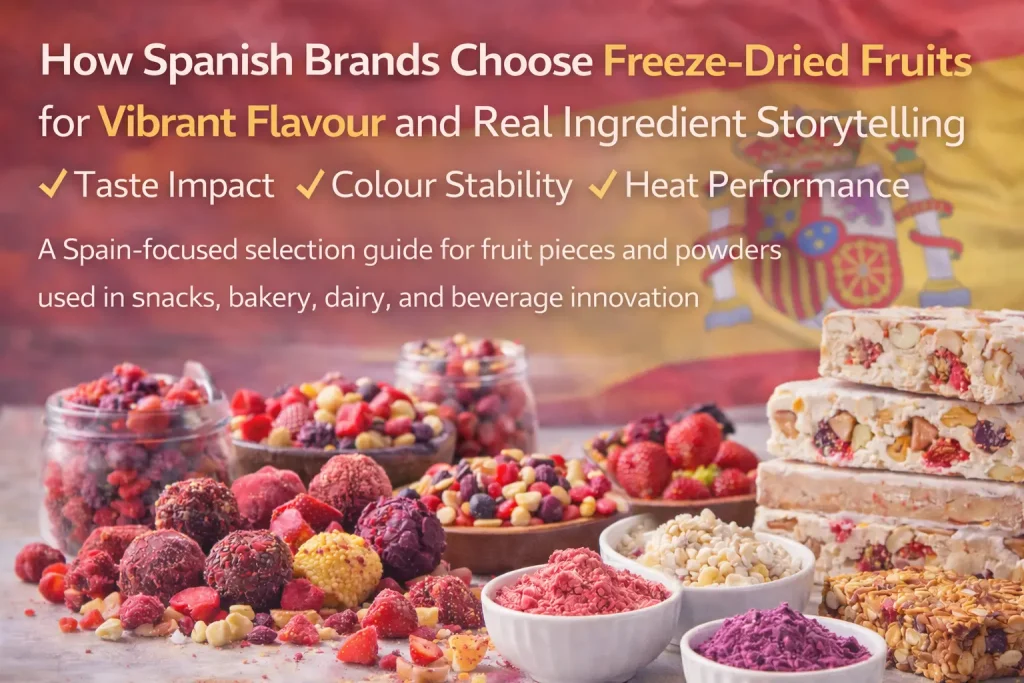
A Spain-focused selection guide for fruit pieces and powders used in snacks, bakery, dairy, and beverage innovation—where taste impact, colour, and heat performance matter most.
Why Spain Treats Freeze-Dried Fruit as a Product Differentiator
Spain is a market that loves flavour with personality. Consumers expect fruit to taste like fruit, not like an abstract “sweet note.” That creates a practical challenge for manufacturers: how do you deliver strong fruit character while keeping formulations stable, scalable, and clean-label friendly?
Freeze-dried fruits and freeze-dried fruit powder fit this need because they deliver concentrated aroma and flavour without adding excess moisture. For Spanish brands, this is especially valuable in snacks, bakery, dairy, and beverage formats where water content can create texture issues, shorten shelf life, or complicate processing.
From a buyer’s point of view, Spain tends to evaluate freeze-dried fruit through two lenses at the same time: sensory impact and production behaviour. A sample that tastes great but fails in a bakery oven is not useful. A fruit powder that looks bright but fades in a yoghurt system is not a win. Selection is about choosing the ingredient that performs in the real product environment.
For teams building a pipeline across fruit pieces and powders, starting from a broad category page helps them map options quickly. A clean way to do that is through your Dried Foods collection, then narrowing to the right format.
Spain’s “Format-First” Decision
Spanish product developers usually decide the fruit format before they decide the fruit variety. That might sound backwards, but it saves time because each format behaves differently during mixing, heating, storage, and packaging.
Fruit pieces and slices are used when visual appeal is part of the product identity. Think premium snack pouches, granola blends, chocolate inclusions, and seasonal gift products. Powders are used when uniform flavour delivery matters more than visuals, such as drink mixes, functional blends, dairy flavour systems, or confectionery fillings.
A practical rule is simple: if the consumer needs to see it, choose pieces. If the consumer needs to feel it consistently in every bite or sip, choose powder.
For powder-focused applications, directing buyers to a dedicated landing page keeps the conversation targeted and avoids confusion. Your Freeze-Dried Fruit Powder page is the natural place for that.
What Spanish Buyers Test in the First Week
Spain moves fast in product development, especially in snacks and seasonal items. Buyers often run quick tests that simulate real manufacturing conditions.
Flavour Impact and Authenticity
Spanish teams want fruit flavour that is recognisable and confident. They will test aroma and taste both in a simple matrix and in the final recipe, because sugar systems, fats, and acidity can shift fruit perception.
They also pay attention to whether the fruit note remains “fresh” or becomes flat after storage. If the fruit character fades quickly, it may not survive distribution and retail time.
Colour Brightness and Visual Consistency
In Spain, visual appetite matters. If fruit pieces look dull, or powders lose their bright tone in a finished product, the product can feel less premium even if the taste is acceptable.
Buyers will test colour under light exposure and across shelf time. They also check colour stability in acidic systems because many Spanish beverages and desserts use bright acidity to lift flavour.
Heat and Process Tolerance
Spanish bakery and confectionery applications are a big driver of freeze-dried fruit. This means buyers test how the ingredient performs under heat.
Common questions include whether the aroma survives baking, whether powders develop bitter edges, and whether pieces become too hard or too chewy after processing.
Flowability and Handling
Even in flavour-driven markets, factory reality wins. Powders that dust heavily, compact during shipping, or bridge in hoppers cause operational pain.
Buyers look for predictable handling: stable flow, easy dosing, and low variability across lots.
Application Mapping for Spain

Spain’s most common use cases cluster around snacks, bakery, dairy, and drinks. The goal is to match ingredient behaviour to the product environment.
| Application | What Spain Typically Prioritises | Common Risk |
|---|---|---|
| snack mixes and granola | strong aroma, visible fruit identity | breakage, uneven distribution |
| bakery and pastries | heat survival, clear fruit top note | aroma loss, bitter aftertaste |
| dairy and yoghurt | colour stability, clean fruit profile | fading, browning |
| confectionery | consistent dosing, concentrated flavour | dusting, flavour drift |
| beverages and drink mixes | fast dispersion, low sediment | clumping, ring residue |
This table helps buyers stop choosing fruit ingredients by marketing label and start choosing by performance.
How Spain Chooses Fruit Powder for Beverages and Functional Blends
Spain’s beverage market is split between refreshing everyday products and more “wellness-led” drinks. Fruit powder is useful in both because it delivers fruit character without needing fruit purée handling.
For beverage applications, Spanish buyers often test dispersion first. They want a powder that mixes without stubborn clumps and does not leave heavy sediment. They also test how the powder behaves in acidic systems, because citrus-forward drinks are common.
If your product development conversations often involve tea-and-fruit blends or hybrid drinks, it is natural to connect the fruit powder story with your tea ingredient capability. Your Tea & Plant Extract Products page provides the right “bridge” without turning this article into a catalogue.
Using Freeze-Dried Fruit in Spanish Bakery and Dessert Innovation
Spain’s bakery culture values aroma and indulgence. Freeze-dried fruit helps deliver real fruit character in products where moisture would otherwise disrupt texture.
In baked goods, a key evaluation point is whether the fruit note stays clear after heating. Some fruits lose brightness when baked; others can develop a cooked note that works well in pastries but not in lighter products.
For dessert toppings and finishing, pieces and slices can add premium identity. The main technical risk is texture shift. If pieces become too hard after storage, consumers may perceive them as stale. If they soften too much, they can look tired. That is why Spanish teams often run texture checks after storage, not only on day one.
For flavours like lemon that are common in Spanish desserts and beverages, buyers often look for versatility across formats. If you want a supporting internal reference that aligns with real buyer questions, your article about lemon slice usage fits naturally as deeper reading: Uses of Freeze-Dried Lemon Slices.
Expert Insights
A Spanish snack developer’s view: fruit inclusion must taste bold without tasting artificial. Freeze-dried fruit works when the aroma is clear and the texture still feels “clean” in the bite, not dusty or chewy in a strange way.
A bakery technologist’s view: the oven is the truth test. If the fruit aroma disappears after baking, the ingredient will not survive scale-up. Testing in the actual bake profile is mandatory, not optional.
A quality manager’s view: most product delays come from inconsistency. When colour, flavour, and particle size vary across lots, internal approval becomes slow. Consistency is what turns trials into long-term supply.
How Fujian Lixing Fits Spain’s Expectations
Fujian Lixing Foods Co., Ltd. specialises in vacuum freeze-dried fruits and vegetables, instant tea powder and tea concentrate, and plant extracts. For Spanish buyers, the most persuasive story is not hype. It is stability: production scale, export experience, and a quality system that supports predictable performance.
For teams who want the company profile, certifications, and capacity context in one place, the most direct page is About Us. For sampling requests or application matching, the clean next step is Contact Us.
If the buyer wants technical reading on ingredient behaviour and storage logic, your learning section is the best destination: Knowledge. For shelf-life conversations specifically, the following resource aligns well with common buyer concerns: Shelf Life of Dried Fruits.
Practical Sample Request Template for Spanish Buyers
Spanish buyers move quickly when the supplier makes sampling easy. A strong request usually includes the application type, target dosage range, whether the product will be heated, the pH environment if it is a beverage or yoghurt, and the expected shelf behaviour.
When those details are provided upfront, the supplier can recommend the most suitable powder or piece format, plus suggested testing steps. That reduces trial-and-error and helps the buyer reach a decision faster.
Conclusion
Spanish brands choose freeze-dried fruit for impact and authenticity, but approval depends on real-world performance: colour stability, heat tolerance, dispersion behaviour, and consistency across lots. The best selection process is format-first, application-driven, and validated in the actual product environment—snacks, bakery, dairy, or beverages. When the ingredient behaves predictably in production and stays vibrant through shelf life, it becomes more than an ingredient; it becomes a product signature that Spanish consumers can taste and recognise.
FAQ
What makes freeze-dried fruit attractive for Spanish snack brands?
It delivers concentrated fruit aroma and flavour without adding moisture, which helps keep snacks crisp and shelf-stable while still tasting like real fruit.
How should manufacturers test fruit powder for Spanish beverages?
Test dispersion in cold and room-temperature liquids, then repeat in the actual drink base to evaluate sediment, colour stability, and flavour clarity over time.
Can freeze-dried fruit work in baked goods without losing aroma?
It can, but it must be tested under real bake conditions. Heat can reduce aroma intensity, so oven validation is essential before scale-up.
Why do some fruit powders clump during mixing?
Clumping often comes from wetting behaviour and handling moisture exposure. Mixing method, storage conditions, and powder characteristics all influence the result.
What should Spanish dairy brands check when using freeze-dried fruit in yoghurt?
They should check colour stability, flavour clarity in a dairy matrix, and whether the fruit note remains fresh across shelf time.
How do brands avoid uneven fruit distribution in snack mixes?
They match piece size to the mix format, control breakage during blending, and verify distribution consistency across batches.
What information speeds up sample approval for Spanish buyers?
Application type, dosage range, whether heating is involved, target flavour intensity, pH environment, and shelf-behaviour expectations.
Does shelf-life testing matter for freeze-dried fruit pieces?
Yes. Storage can change texture and colour perception, so post-storage evaluation helps confirm the ingredient stays premium through the intended product life.